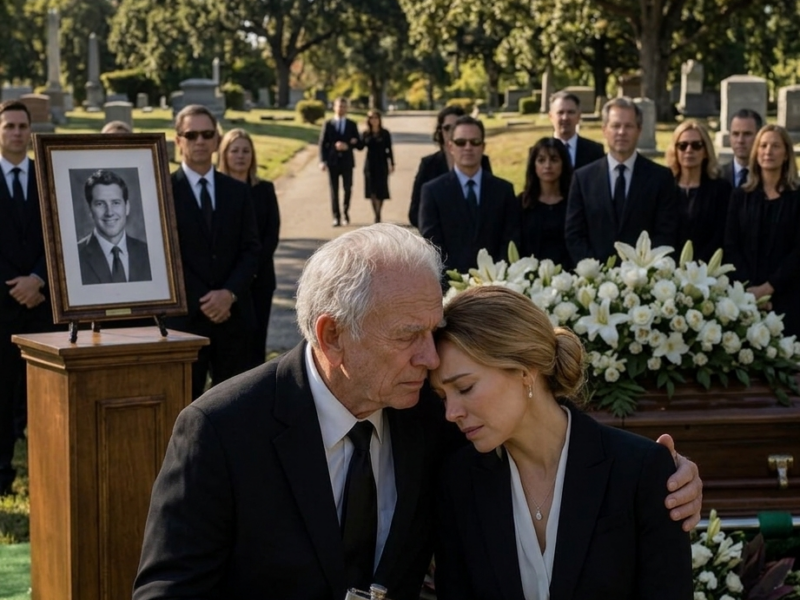
After 36 Years of Marriage, We Divorced — Then My Ex-Husband’s Father Revealed a Secret at His Funeral
My husband and I ended our marriage after thirty-six years together. Then, at his funeral, his father drank too much, leaned toward me, and said something that made me question everything.
“You have no idea what he did for you, do you?”
Troy had been part of my life since we were five years old.
Our families lived next door to each other, so we grew up sharing the same neighbourhood, schools, and childhood memories. We eventually fell in love, married at twenty, and spent the next thirty-six years building a family.
We raised two wonderful children, bought a home, and created the kind of ordinary, dependable life I believed would last forever.
For most of our marriage, I thought we were happy.
Then I discovered the missing money.
One afternoon, I logged into our joint bank account after our son repaid part of an old loan.
The numbers immediately looked wrong.
Several large transfers had been made over the previous months, and thousands of dollars were gone.
When I asked Troy about them, he avoided giving me a clear answer.
“Bills,” he said first.
Then it was something for the house.
After that, he claimed he had simply moved the money between accounts.
None of his explanations matched the transactions.
A week later, I went through his desk looking for spare batteries and found a stack of hotel receipts hidden beneath some papers.
Every receipt came from the same hotel.
The same city.
Even the same room.
The dates stretched back for months.
Desperate for an explanation, I called the hotel and pretended to be Troy’s assistant.
The concierge recognised his name immediately.
“Of course,” he said. “Mr. Whitmore is a regular. That room is practically reserved for him.”
My stomach dropped.
That evening, I placed the receipts on the kitchen table and waited for Troy to come home.
He looked at them but never denied they belonged to him.
“It isn’t what you think,” he said.
“Then tell me what it is.”
He refused.
No matter how many times I asked, Troy would not explain the hotel, the missing money, or the months of secrecy.
After thirty-six years together, I could not remain married to someone who expected my trust while deliberately hiding the truth.
So I filed for divorce.
Troy did not fight me.
He signed the papers, walked away, and took the mystery with him.
Two years later, he died unexpectedly.
I attended the funeral, although I was no longer certain what place I held in his life.
Near the end of the service, Troy’s eighty-one-year-old father approached me. He was unsteady, emotional, and smelled strongly of whiskey.
He leaned closer and stared directly into my eyes.
“You don’t even know what he did for you, do you?”
Troy’s father leaned closer, his breath sharp with whiskey.
“You don’t even know what he did for you, do you?”
For a moment, I thought I had misheard him.
Around us, the funeral reception continued in muted fragments. Silverware touched china. Ice shifted in glasses. Someone near the windows laughed too loudly, then immediately lowered their voice as if remembering where they were.
I stared at Walter Whitmore, the man who had lived next door to my parents for most of my childhood, who had taught Troy and me how to ride bicycles without training wheels, who had danced with me at my wedding and called me his daughter for thirty-six years.
“What are you talking about?” I asked.
Walter’s eyes were wet and unfocused, but there was something beneath the grief. Something close to anger.
“He let you hate him,” he said. “That’s what he did.”
My heart gave a hard, painful beat.
Before I could ask another question, Troy’s younger sister, Elaine, appeared at Walter’s side.
“Dad,” she said sharply. “That’s enough.”
She took his arm, but he pulled away.
“No,” Walter snapped. “She should know. She should have known before she signed those papers.”
Elaine’s face changed.
It was slight. A tightening around her mouth. A flash of fear in her eyes.
I saw it.
And once I saw it, I understood that Walter’s words were not the confused ramblings of a grieving old man.
There was a secret.
A real one.
“What should I have known?” I demanded.
Elaine stepped between us.
“He’s drunk, Marianne.”
“I can see that.”
“He doesn’t know what he’s saying.”
Walter laughed bitterly.
“Oh, I know. I know exactly what I’m saying.”
Several people nearby turned to look.
Elaine lowered her voice. “Dad, please.”
Walter jabbed a trembling finger toward me.
“Ask her about Room 314.”
The room seemed to tilt.
I gripped the edge of the nearest table.
Elaine went pale.
The hotel receipts had listed Room 314.
Every one of them.
Walter knew.
I looked at Elaine. “How does he know about that room?”
She did not answer.
“Elaine.”
“Not here.”
“Then where?”
She glanced around the reception hall, at the clusters of mourners pretending not to listen.
“Come outside.”
Walter tried to follow, but Elaine’s husband stepped forward and gently took his arm. Walter resisted at first, then sagged against him, suddenly looking every one of his eighty-one years.
Elaine led me through a side door into the church courtyard.
It had rained earlier, and the stone path shone beneath the gray afternoon light. Water clung to the bare branches overhead. Somewhere beyond the brick wall, traffic hissed over wet pavement.
Elaine wrapped her arms around herself.
For several seconds, neither of us spoke.
I could hear my own pulse.
“Tell me,” I said.
She closed her eyes.
“I promised Troy I wouldn’t.”
“Troy is dead.”
The words sounded cruel, but I did not take them back.
Elaine flinched.
“I know.”
“Your father just told me Troy allowed me to hate him. He mentioned the hotel room. I spent two years believing my husband had stolen from me and carried on an affair. I divorced him because he refused to tell me the truth.”
Elaine’s eyes filled with tears.
“I know.”
“No, you don’t know. You watched me bury thirty-six years of marriage because your brother stood in our kitchen and looked me in the face and chose silence.”
“He was trying to protect you.”
“From what?”
Elaine looked toward the church door.
Then she said, “From your son.”
I stopped breathing.
The courtyard seemed to go utterly silent.
“What did you say?”
She hugged herself tighter.
“Daniel was in trouble.”
I almost laughed, not because anything was funny, but because the answer was so absurd.
“Our son?”
“Yes.”
“What kind of trouble?”
“The kind that could have destroyed his life.”
I shook my head.
“No. Daniel borrowed money from us years ago for his business. He paid part of it back. That was why I noticed the missing money in the first place.”
“The business loan wasn’t the problem.”
“Then what was?”
Elaine hesitated.
That hesitation frightened me more than the words.
“Tell me.”
“Troy found out Daniel had been gambling.”
I stared at her.
“Daniel doesn’t gamble.”
“He did.”
“No.”
“He started online. Sports betting, mostly. Then private games. He lost more than he could cover.”
A memory surfaced without warning.
Daniel arriving late to Christmas dinner three years earlier, smiling too quickly, saying traffic had been terrible. His hands had shaken while he carved the turkey.
I had thought he was exhausted.
Elaine continued.
“He borrowed from people he shouldn’t have borrowed from.”
“How much?”
“I don’t know the full amount.”
“How much, Elaine?”
“Over two hundred thousand dollars.”
The number did not make sense.
It was too large to belong to my son. Too large to fit inside our orderly family, our Sunday dinners, our birthday phone calls, our dependable life.
“That’s impossible.”
“Troy said the same thing.”
“Why didn’t Daniel come to me?”
“Because Troy made him promise not to.”
I felt something inside me twist.
“Why?”
“Because Troy believed the shock would destroy you.”
“Destroy me?”
“He said you had already spent years worrying about Daniel’s business. He knew how proud you were of him. He thought if you found out the truth—”
“He thought I was too weak to know my own son?”
“No. He thought you would try to fix it.”
“Of course I would have tried.”
“And that was what terrified him.”
Elaine stepped closer.
“The people Daniel owed money to were not ordinary lenders. Troy said they had threatened Daniel’s wife. They knew where the children went to school.”
Cold spread slowly through my arms.
Daniel had two daughters.
Sophie was twelve.
Lily was nine.
I pictured them in their blue school uniforms, backpacks bouncing as they ran through our kitchen.
“What does the hotel have to do with any of this?”
Elaine looked away.
“Troy met them there.”
“In Room 314?”
“Yes.”
My stomach clenched.
“Why always the same room?”
“It was controlled. No cameras inside. Private entrance through the parking garage. Troy didn’t want anyone seeing Daniel with them.”
“So Troy went instead.”
She nodded.
“He negotiated payments. He sold some investments. Took money from your joint account. Cashed out part of his retirement.”
Every missing transfer flashed through my mind.
Eight thousand.
Twelve thousand.
Twenty-five thousand.
Each one a payment.
Each one hidden behind a lie.
“He stole from me,” I whispered.
Elaine’s expression hardened.
“He used the money to keep your son alive.”
“He could have told me.”
“Troy thought the less you knew, the safer you were.”
“That wasn’t his decision to make.”
“I agree.”
Her answer surprised me.
Elaine looked down at the wet stones.
“I told him that. Many times. I told him the secrecy would ruin your marriage. He said he could live with losing you if it meant you were safe.”
A sound escaped me, something between a breath and a sob.
“No.”
“He believed the men Daniel owed were watching the family. Troy thought if your divorce looked real—if you genuinely hated him—you would be separated from the debt and from whatever happened next.”
I remembered Troy standing in our kitchen, the hotel receipts spread between us.
His face had been strangely calm.
It isn’t what you think.
Then tell me what it is.
And he had looked at me for a long time.
I had believed his silence was indifference.
Now I wondered if it had been fear.
“When did Daniel’s debt begin?” I asked.
“About a year before you found the receipts.”
“And when did it end?”
Elaine said nothing.
I looked at her.
“When did it end?”
“It didn’t.”
The courtyard blurred at the edges.
“What do you mean?”
“Troy made payments for months. He thought he had settled everything. Then the amount changed. Fees. Interest. New claims. The men kept demanding more.”
“Extortion.”
“Yes.”
“And Troy continued meeting them?”
“Yes.”
“For how long?”
“Until he died.”
The church door opened behind us. A couple stepped outside, saw our faces, and quietly turned the other way.
I lowered my voice.
“Troy died of a heart attack.”
Elaine did not respond.
The official explanation had been simple. Troy had collapsed in his apartment late on a Tuesday evening. His neighbor found him the next morning after noticing his front door partly open.
No sign of forced entry.
No suspicious injuries.
A massive cardiac event, according to the preliminary report.
Troy had been fifty-eight.
Too young, everyone said.
Tragic, but natural.
I studied Elaine’s face.
“Didn’t he?”
Her chin trembled.
“The coroner ruled it natural.”
“That isn’t what I asked.”
She pressed her lips together.
“Elaine.”
“I don’t know.”
I stepped back.
“You think someone killed him?”
“I think Troy was afraid during the last few weeks of his life.”
“How do you know?”
“He called me.”
“When?”
“Three days before he died.”
“What did he say?”
“He asked me to take care of Dad. He asked whether I still had the key to the old lake house. Then he said if anything happened, I should wait until after the funeral and give you a package.”
The blood drained from my face.
“A package?”
She nodded.
“Where is it?”
“At my house.”
“You were going to give it to me?”
“I didn’t know.”
“You just said he told you to.”
“He also said giving it to you might put you in danger.”
My grief shifted.
Until that moment, it had been heavy and dull, a weight I carried because someone who had occupied nearly my entire life was gone.
Now it sharpened into something else.
Anger.
“At your house,” I said. “We’re going now.”
“Marianne—”
“Now.”
Elaine glanced toward the church.
“I have to take Dad home.”
“Have your husband take him.”
“He’s not in any condition—”
“Neither am I.”
She stared at me.
Then she nodded.
We left through the side gate.
I did not tell Daniel where I was going.
He was inside the reception hall with his wife, accepting condolences for a father he had apparently allowed me to despise.
That thought sat in the passenger seat beside me as I followed Elaine’s car across town.
Daniel had known.
Maybe not about the hotel receipts, not at first. But he had known Troy was paying his debt. He had known why money vanished. He had known why his parents’ marriage ended.
And for two years, he had said nothing.
When I filed for divorce, Daniel had been devastated.
Or he had pretended to be.
“I don’t understand Dad anymore,” he had told me.
He had hugged me in my kitchen and said, “You deserve the truth.”
The memory made my hands tighten around the steering wheel.
Elaine lived in a narrow brick house at the edge of town. Her husband stayed behind with Walter, so we were alone when she unlocked the front door.
The house smelled faintly of coffee and furniture polish.
She led me upstairs to a small office.
From the back of a closet, she removed a black metal box with a combination lock.
“Troy gave me this eight months ago,” she said.
“You said he called three days before he died.”
“He called to remind me.”
“Eight months,” I repeated. “You had this while he was alive.”
“Yes.”
“And you never opened it?”
“He told me not to.”
I laughed once, bitterly.
“The Whitmore family loyalty to Troy’s secrets is remarkable.”
Elaine absorbed the insult without defending herself.
“He gave me the combination,” she said. “Your wedding date.”
My fingers went numb.
May 17.
She entered the numbers.
The lock clicked.
Inside were three sealed envelopes, a flash drive, a burner phone, and a small brass key.
My name was written across the first envelope in Troy’s handwriting.
Marianne.
I touched the letters.
For thirty-six years, I had watched him write grocery lists, birthday cards, checks, permission slips, and notes left beside the coffee machine.
His handwriting had always leaned slightly to the right.
Seeing my name now felt more intimate than touching his body in the coffin.
I opened the envelope.
Marianne,
If you are reading this, then either I failed to solve the problem or I ran out of time.
I know what you believe about me.
I know what the receipts look like. I know what the missing money looks like. I also know that silence cost me our marriage.
I wish I could tell you I made the right choice. I don’t know if I did.
I only know I chose the risk I could live with.
You angry and alive.
Daniel ashamed but alive.
The girls untouched.
I thought I could keep paying until I found a way out. I was wrong.
There are things about Daniel’s situation that he has not told anyone, including me. The debt was not simply gambling. He was involved in moving money through his company. At first, he claimed he did not understand what he was doing. Later, I learned that was not true.
My eyes stopped on the sentence.
I read it again.
He was involved in moving money through his company.
I looked up at Elaine.
“Did you know about this?”
She shook her head.
I continued.
The men in Room 314 were not collecting a debt. They were buying my silence.
Daniel used company accounts to transfer money for them. When one of the transfers disappeared, they blamed him. Daniel came to me because he believed they would kill him.
I paid what I could.
Then I discovered Daniel may have taken the missing money himself.
I lowered the letter.
The room seemed smaller.
“That can’t be true.”
Elaine said nothing.
I forced myself to read on.
I confronted him. He denied it. I wanted to believe him.
But there are records on the enclosed drive. Copies of accounts, messages, names, and dates. I left them in a form that cannot easily be traced to you.
Do not open the second envelope unless you are prepared to learn something about our son that you may never forgive.
Do not use the phone unless someone contacts you first.
The key is for a safe-deposit box at First County Bank. It is under your maiden name.
Marianne, I am sorry.
Not only for the lies, but for the pride that made me think I could carry this alone.
There is something else I need you to know.
I never had an affair.
I never stopped loving you.
Not for one day.
I pressed the page to my mouth.
For two years, I had rehearsed all the ways Troy had betrayed me.
I had imagined another woman waiting in that room. I had pictured him laughing with her, touching her, spending our money on her.
I had hated him for making me feel foolish.
Now he was speaking to me from a page, and the truth was worse.
He had not chosen another woman.
He had chosen our son.
Again and again.
Even when it destroyed us.
“I need a moment,” I whispered.
Elaine left the room.
I sat alone at the desk, holding Troy’s letter.
The rain began again, tapping softly against the window.
I remembered the day he moved out.
He had packed only two suitcases.
At the front door, he had turned back and looked at the hallway where our children’s school photographs still hung.
“I hope one day you understand,” he had said.
I thought he was asking forgiveness for an affair.
I told him, “There is nothing left to understand.”
He nodded.
Then he walked away.
I cried now, but quietly.
There was no relief in learning he had loved me.
Love had not saved us.
His version of love had removed my choices, treated me like something fragile to be placed on a high shelf while the men in my family made decisions below.
Still, beneath my anger, grief opened like a wound.
He had died believing I despised him.
I wiped my face and reached for the second envelope.
The warning stared at me.
Do not open unless you are prepared.
A mother is never prepared to discover her child is a stranger.
I opened it anyway.
Inside was a photograph.
Daniel stood in the hotel parking garage beside a black sedan. The picture was grainy, taken from a distance, but there was no mistaking him.
He was shaking hands with a tall man in a dark coat.
On the back, Troy had written a date.
Six months before I found the receipts.
Beneath the photograph was a single sheet of paper.
The first name listed was Daniel’s.
The second was Victor Saye.
The third made my skin turn cold.
Evan Mercer.
I knew that name.
Everyone in town knew it.
Evan Mercer was a real-estate developer, a generous donor, and a longtime friend of our family.
He had attended the funeral that morning.
He had stood beside Daniel during the service.
He had hugged me near Troy’s coffin and whispered, “Troy was one of the best men I ever knew.”
At the bottom of the page, Troy had written:
Mercer is not part of the group.
He is in charge of it.
I heard Elaine return before I saw her.
“Marianne?”
I held up the page.
“Did you see Evan Mercer today?”
“At the funeral? Yes.”
“He was working with the men Troy met.”
Elaine came closer and read the page.
Her hand flew to her mouth.
“That doesn’t make sense. Evan and Troy were friends.”
“So were Troy and I.”
The words came out harsher than I intended.
I picked up the burner phone.
It was an inexpensive black device, powered off.
“Don’t,” Elaine said.
“Troy said not to use it unless someone contacted me first.”
“Then don’t turn it on.”
Before I could answer, the phone vibrated in my hand.
Elaine gasped.
The screen lit up.
The device had not been off after all. It had been sleeping.
One new message appeared.
UNKNOWN NUMBER.
I opened it.
The message contained no greeting.
Only a photograph.
It had been taken less than an hour earlier at the funeral reception.
Daniel stood near the church windows, his head bowed as Evan Mercer spoke into his ear.
Behind them, slightly out of focus, was my granddaughter Sophie.
Beneath the photograph was a sentence.
YOUR HUSBAND FAILED TO HONOR HIS AGREEMENT.
A second message appeared.
NOW THE DEBT BELONGS TO YOU.
Elaine gripped my arm.
“Call the police.”
I was about to agree when a third message arrived.
This one was a video.
Ten seconds long.
I pressed play.
At first, the image was dark and unsteady. Then the camera focused on a familiar room.
Blue wallpaper.
A brass lamp.
Heavy curtains.
Room 314.
A man sat in a chair with his back to the camera.
Someone entered the frame and placed a glass of water on the table beside him.
The seated man turned slightly.
Troy.
Alive.
The date stamp in the corner was from the night he died.
My breath stopped.
Troy looked exhausted. His shirt collar was open, and sweat shone across his forehead.
A voice behind the camera asked, “Where is the drive?”
Troy answered, “Somewhere you’ll never find it.”
The voice said, “Your son says otherwise.”
Troy’s face changed.
Not fear.
Betrayal.
Then Daniel stepped into the frame.
My son stood directly in front of his father.
Troy looked up at him.
“Danny,” he whispered.
Daniel did not answer.
He reached into his coat pocket and removed a small glass vial.
The video ended.
I stared at the frozen screen.
“No,” Elaine whispered. “No, that could be edited.”
The phone vibrated again.
A final message appeared.
ASK YOUR SON WHO POISONED TROY.
Downstairs, someone knocked on Elaine’s front door.
Three slow knocks.
Elaine and I looked at each other.
The knock came again.
Then my phone rang in my handbag.
Daniel’s name appeared on the screen.
I answered without speaking.
For several seconds, all I heard was his breathing.
“Mom,” he said.
His voice sounded strained.
“Where are you?”
I looked at the burner phone in one hand and Troy’s letter in the other.
“Why?”
“You need to leave Elaine’s house.”
Every hair on my arms rose.
“How do you know I’m here?”
Silence.
Then Daniel said, very softly, “Because the man at the door isn’t there to talk.”
The front door opened downstairs.
Elaine’s face drained of color.
We heard footsteps enter the hall.
Measured.
Unhurried.
Daniel whispered into my ear.
“Mom, listen to me. Take the brass key and go out the back window. Do not trust Elaine.”
I turned toward her.
She was already standing behind me.
And in her hand was a gun.