Parents, check your children’s toys now: Young girl suffers severe burns after a popular fidget toy explodes
In the world of children, curiosity often walks hand-in-hand with unforeseen risks, especially when viral “life hacks” from social media serve as the blueprint for activities at home. The recent story of 10-year-old Violet Zerbst in the Gold Coast, Australia, is not merely a cautionary tale; it is a wake-up call for parents regarding the toxic trends currently circulating on TikTok, Instagram, and YouTube.
From Harmless Play to the Emergency Room
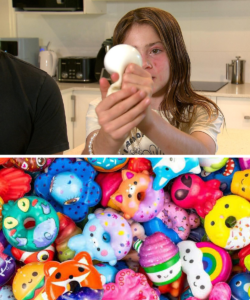
It all began with an innocent thought: how could a “squishy” toy be made softer and more pleasant to handle? For Violet, the answer lay in the microwave. She recalled: “If it’s really hard, you think… warm it up.”
With just 30 seconds in the microwave, an otherwise harmless squishy toy was transformed into a thermal “bomb.” Violet recounted the terrifying moment: “So I went to the microwave and I put it in for 30 seconds and I was just waiting and then I got it and I was just squishing it. The liquid was like at the bottom and then it went into a sort of ball and it burst onto my face.”
The consequences were immediate: superheated chemicals splashed directly onto her face, lips, and mouth. Her father, Jody Zerbst, recounted the shock: “It literally just exploded.” For any parent, there is no pain quite like hearing their child scream in agony from such severe injuries. “It’s just quite a horrific for a parent to have to hear their child screaming and know that they’d burnt themselves,” he shared.
The Hidden Weight of Responsibility and Regret
What makes this incident even more heartbreaking is the guilt now borne by her father—the man who inadvertently suggested softening the toy. He described that fateful Sunday morning: “I was trying to enjoy the soccer. It was Sunday morning and I think Brazil were playing and I felt a little bit guilty actually because I had made the comment that if it (the squishy) was heated up it might be a bit softer but not thinking that Violet would put it in the microwave.”
Violet’s burns were so severe that the skin peeled away from her face, and because the liquid had entered her mouth, she endured agonizing moments trying to spit it out. “A lot of pain. I could feel my skin coming off. And it was in my mouth,” she said.
A Pricey Lesson in the Digital Age
From a medical perspective, experts emphasize that this is not an isolated case. Dr. Veevek Thankey, a burns specialist at the Queensland Children’s Hospital, warned: “First of all, toys should not be going into the microwave.” He also provided urgent advice on first aid: “We would want parents to initiate first aid management as soon as the burns happen. Whichever body part that’s been affected by the burns run under cool running water for at least 20 minutes. Make sure that no ice actually put onto the burn because that will actually make the burn worse.”
The core of the issue lies in the fact that while reputable toy manufacturers often provide clear warnings against heating, freezing, or microwaving their products, the market is currently flooded with cheap knock-offs that lack any safety instructions whatsoever.
Violet spent a week in the hospital recovering, but the physical and psychological scars of this ordeal will linger. This trend has not only left its mark on her face but serves as a stern reminder of the dangers posed by the lack of oversight on social media content. It is time for parents to become more aware of the “power” of online trends and educate their children that not everything that goes viral is safe. May Violet’s story be the final lesson for this inherently dangerous trend.