Chapter 1: The Alarm Beneath the Floor
Monday morning at Jefferson Elementary School was unusually bright. The sun spilled through the tall cafeteria windows, casting rectangular patches of light across the linoleum floor. The scent of disinfectant mingled with the faint aroma of reheated pancakes, creating a strangely domestic atmosphere—one that promised nothing more dangerous than spilled juice or a scrape on the playground.
Teachers shuffled in, clutching oversized coffee mugs, exchanging half-hearted greetings, and reviewing lesson plans. Students traipsed in with backpacks too heavy for their small shoulders, chattering about weekend games, cartoons, and the usual trivialities of elementary life. In short, it was a day like any other.
Except it wasn’t.
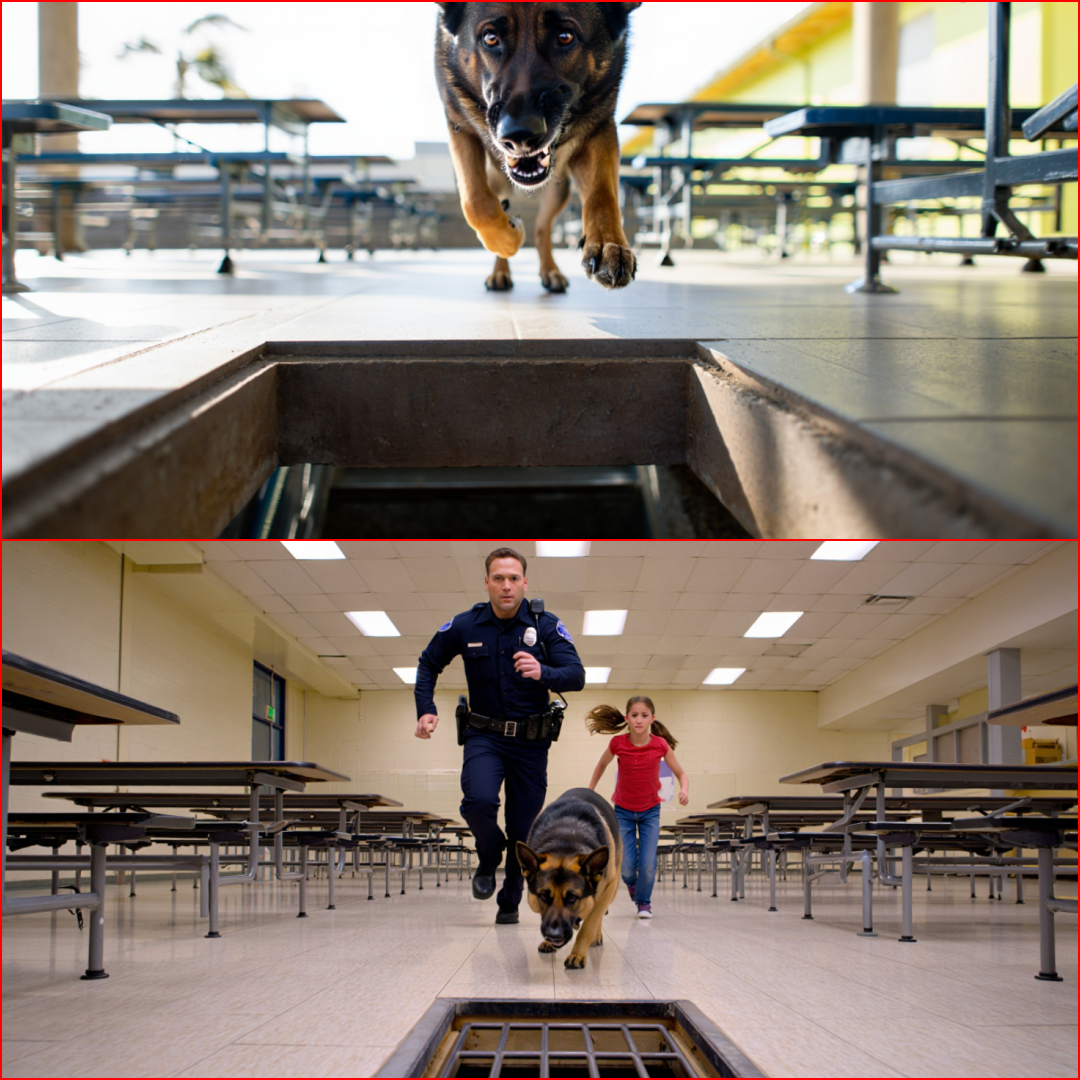
Officer Daniels strode through the cafeteria with Bolt, the department’s K-9, at his side. The German Shepherd moved with disciplined calm, muscles rippling beneath his sleek, black-and-tan coat. Children squealed and reached out, and Bolt allowed a few tentative pets, tail swishing once, almost lazily. His eyes, however, scanned the room with a precision that no child could understand, and Daniels knew from years of experience: Bolt noticed things.
“Alright, everyone, give Bolt some space,” Daniels said, his voice a low murmur as he guided the dog toward the middle of the room. “He’s on duty today.”
Bolt’s ears twitched. A low growl hummed in his throat, barely audible at first, but Daniels felt it in his chest, vibrating like a warning drum.
“Probably just the floor heating,” whispered Ms. Langley, the third-grade teacher, as she adjusted her scarf. “Dogs are so dramatic sometimes.”
Daniels didn’t answer. He simply watched.
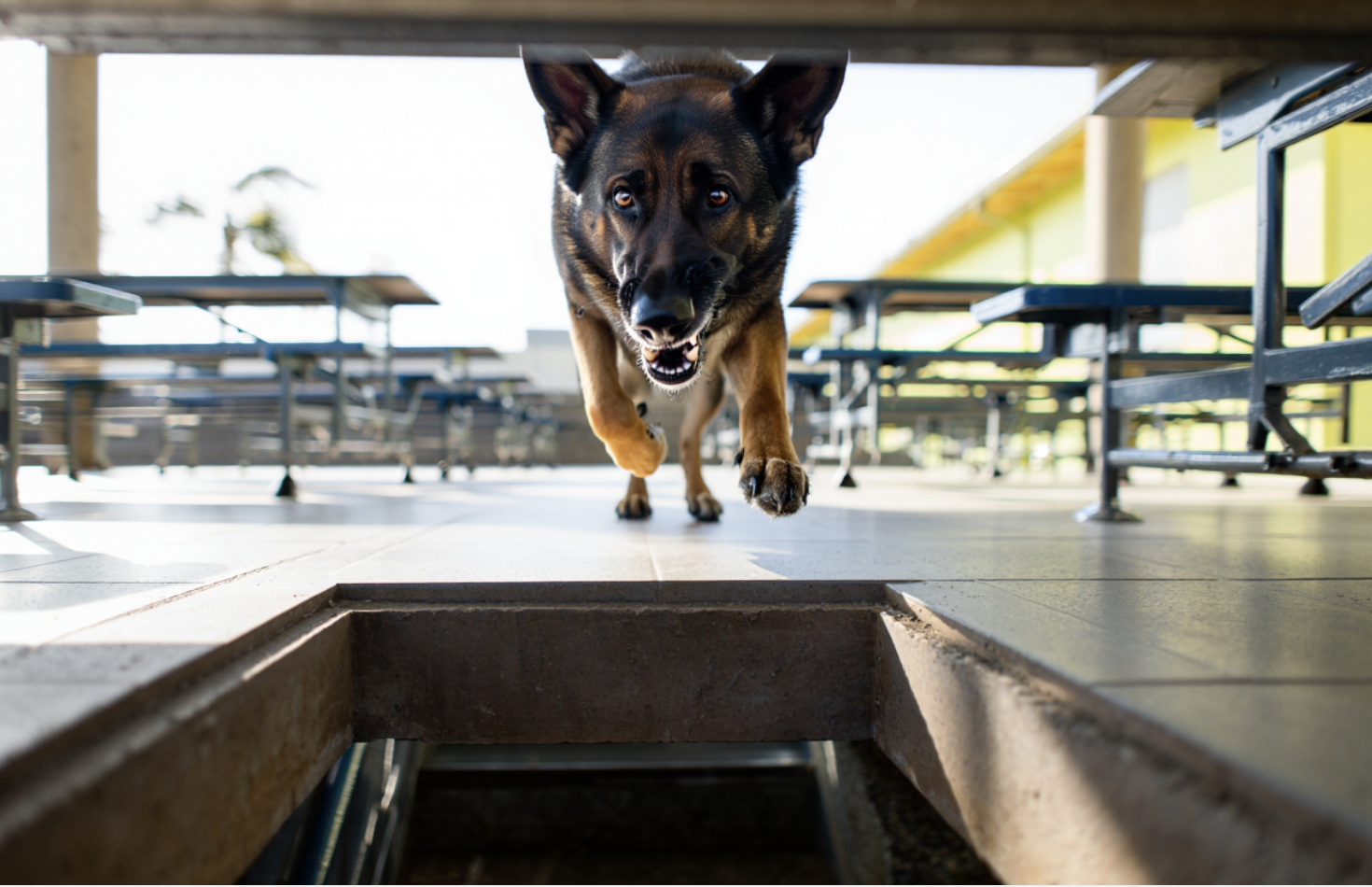
Bolt’s pace slowed—not a cautious walk, but a sudden stop. He froze like a statue, muscles coiled, tail lowered, nose pointed. Daniels followed his gaze. There, near the far corner of the cafeteria, a metal floor grate glinted faintly under the fluorescent lights.
“Bolt?” Daniels said softly, kneeling to get eye level with him. The dog did not respond. His growl deepened, rolling through the floor like distant thunder. Then came the bark: short, sharp, explosive. The sound ricocheted off the walls. Several teachers jumped. Students gasped and stepped back, gripping each other’s hands.
“What is it?” someone asked nervously.
Daniels took a slow breath. “Something’s under that grate.”
“A mouse?” whispered a student. Her voice was tiny, almost lost under Bolt’s relentless barking.
“No,” Daniels said firmly, already signaling teachers to move children toward the opposite side of the room. “It’s not a mouse.”
Bolt lunged forward, claws scraping metal, his body vibrating with intensity. Daniels grabbed his harness, pulling him back, but the dog’s instinct was relentless. The snarling, barking, tense posture—it was a high-level detection alert. This wasn’t curiosity. This wasn’t a normal animal encounter. This was danger.
Another officer arrived, confusion written across his face. “What’s all the noise?”
“Bolt’s found something,” Daniels said, eyes never leaving the dog. “He won’t leave it. Clear the area.”
“Clear the area?” the new officer repeated, stepping closer.
“Yes. Now,” Daniels said, his voice edged with steel. “We move the kids, no questions.”
Teachers scrambled. “Line up! Everyone, against the wall! Quickly!” shouted Ms. Langley, her voice trembling despite her attempt at authority.
The cafeteria filled with the buzz of panicked children, feet shuffling, murmured cries. Bolt’s barks grew louder, more urgent, resonating through the air. His nose nearly pressed against the grate, and he pawed at it violently, claws scraping metal in staccato bursts.
Daniels swallowed hard. “Alright, let’s see what we’re dealing with,” he muttered under his breath. He signaled the second officer to fetch tools from the squad truck. Another officer knelt beside him, flashlight in hand.
“What do you think it is?” the young officer asked. His voice was tight, uncertain.
Daniels didn’t answer immediately. He squatted next to the grate, careful to keep Bolt restrained. His fingers hovered over the edges of the metal mesh, feeling vibrations through the floorboards. Nothing sounded normal. No scampering, no squeaks—just a dull, low hum, almost mechanical in nature.
“What is it, boy?” Daniels murmured. Bolt’s ears flicked, a low growl emanating, and the dog’s tail thumped against the floor in agitation.
Then, a sudden noise: a faint click, almost imperceptible, beneath the grate. Daniels stiffened. His training kicked in. He signaled the team. “Step back. Everyone step back.”
Teachers froze mid-motion, children staring wide-eyed. Bolt barked again, frantic and loud, as if to warn them all. The metal grate itself vibrated slightly under the force of the dog’s claws.
Daniels spoke into his radio, voice clipped. “Control, we have a situation. Possible underground device. Cafeteria. Evacuate to outer perimeter.”
There was a pause, then a crackled response: “Copy. Units en route. Keep safe distance. K-9 on site?”
“Yes. Bolt is engaged. Standby.” Daniels felt a cold sweat along his spine.
Bolt’s growl intensified. His body shook with anticipation. Then came the next noise: a faint hissing, metallic, almost electrical. Daniels felt a sudden, visceral dread. Whatever was under that grate wasn’t small. It wasn’t harmless. And it wasn’t something they could simply ignore.
A few children whimpered. Daniels met their eyes, forcing calm into his voice. “It’s okay. You’re safe. Just stay here.”
Bolt lunged suddenly, breaking the leash for a fraction of a second. Daniels caught him, heart hammering. The dog’s teeth bared in frustration, tail stiff, muscles taut. The metal grate groaned under the pressure, the vibrations resonating like a heartbeat that didn’t belong to the school.
“What is it, Daniels?” the second officer asked, voice tight.
“I don’t know,” Daniels admitted, jaw clenched. “But Bolt wouldn’t react like this unless it was serious.”
Bolt barked again, a sequence of rapid-fire, urgent commands that only another K-9 handler might interpret. But there was no misreading it. Danger. Immediate. Hidden. And deadly.
Daniels took a step back. He looked at the children, huddled near the far wall, and then at the metal grate vibrating beneath Bolt’s paws. He knew, in that instant, that the calm Monday morning had ended. The nightmare waiting beneath the floor had begun.
Chapter 2: The Hidden Threat
The cafeteria had become a tense, frozen tableau. Children clung to one another, eyes wide, whispering questions they were too afraid to voice aloud. Teachers pressed against the walls, trying to appear calm while their hearts raced. The metallic hum under the grate, now louder and more insistent, seemed to pulse through the linoleum like a warning drum.
Bolt’s growls grew sharper, each bark more desperate than the last. His eyes locked onto the grate, unwavering, unblinking, as if he could see through the floor itself. Daniels felt a shiver run down his spine. He had handled dozens of dangerous situations before—bomb threats, armed suspects, drug busts—but the raw, primal intensity emanating from his K-9 today was unlike anything he’d experienced.
“Get the breach tools,” Daniels barked into his radio. His hands gripped Bolt’s harness tightly, keeping him restrained. “We need to open this grate—carefully.”
A team of officers arrived moments later, wheels clattering on the linoleum as they approached with crowbars, bolt cutters, and flashlights. Daniels nodded to them, his eyes never leaving the dog.
“Stand back, everyone,” he warned, his voice steady, cutting through the rising panic. “No one near the grate except trained personnel.”
Bolt’s ears flicked. His growl was now continuous, a low, menacing rumble that seemed to vibrate the very air. Daniels took a deep breath and motioned for Officer Ramirez to start prying at the edges of the metal grate. The tools scraped against metal with a harsh, grating sound. Bolt barked sharply, lunging forward, teeth bared, sending a jolt through Daniels’ arm.
“Easy, boy,” Daniels said, voice tight. He could feel Bolt’s tension radiating outward, a living, trembling warning.
The grate began to shift. Dust and faint odors of soil and oil seeped through the slats. Daniels’ stomach tightened. Whatever lay beneath wasn’t just a trap—it was deliberate, constructed, and waiting.
“Something’s moving down there!” Ramirez called, shining his flashlight into the narrow opening.
Daniels crouched beside him, heart hammering. His breath caught. There, barely visible under the flickering cafeteria lights, was a tangle of wires and a metallic cylinder. He froze.
“Is that… a bomb?” whispered Ms. Langley, clutching her scarf like a lifeline.
Daniels didn’t answer. He simply signaled for everyone to move back further. “Everyone out,” he said, voice low but commanding. “Now.”
The children, confused but obedient, were guided to the far side of the cafeteria. Bolt, though restrained, was straining, whining, growling—every instinct screaming danger. Daniels knelt beside the grate, studying the device. It was small, compact, and menacing in its simplicity: a cylindrical object wired to a timer with frayed, exposed connections.
“Who the hell puts something like this under a school cafeteria floor?” muttered Officer Ramirez. His hand trembled slightly as he pointed the flashlight.
Daniels didn’t answer. There was no time. Every second counted. Bolt’s barking was frantic now, almost desperate, as if the dog understood more than they did.
“Control,” Daniels said into his radio, his voice clipped and urgent. “Confirmed device. Under cafeteria floor. Evacuated students. Need bomb squad—immediate. Do not attempt to handle without specialists.”
“Copy that, Daniels. Squad en route,” came the response, crackling over the radio. “Keep safe distance. Stand by.”
Daniels glanced at Bolt. The dog was rigid, muscles coiled, growling at the grate like a predator guarding its territory. Daniels knew from experience: K-9s could sense things humans couldn’t—heat signatures, chemical traces, and yes, even explosives. Bolt’s instincts weren’t wrong.
Then the first movement happened. A faint click, then a low hiss. Dust puffed from the grate. Daniels’ heart skipped. “Step back!” he shouted.
Bolt lunged again, teeth snapping inches from the grate. Officer Ramirez barely had time to restrain him. The device emitted a soft, almost imperceptible whirring sound, then a faint red light blinked ominously. Daniels’ stomach dropped.
“Timer’s active,” he muttered under his breath. “We don’t have much time.”
Suddenly, a voice rang out from the entrance to the cafeteria. “Freeze!”
Everyone turned. A man in dark clothing, partially masked, emerged from the shadows near the door, carrying a backpack. His eyes were hidden, but Daniels could see the tense set of his shoulders, the way he gripped the bag.
“Everyone stay calm,” the man shouted, voice loud, shaking slightly. “Nobody moves, and nobody gets hurt!”
Daniels’ eyes narrowed. “You’ve got two options,” he said calmly, though adrenaline surged through him. “Drop the bag. Walk away slowly. No one has to get hurt.”
The man hesitated. Then, with a sudden surge, he slammed the bag onto the floor and bolted toward the exit. A loud thud resonated—something inside the bag rattled violently. Daniels’ heart raced.
“Bolt!” he shouted. The dog lunged forward with a ferocity that made even hardened officers flinch. Bolt chased the man a few steps, then barked sharply, signaling back to Daniels—always returning to the grate. The instinct was clear: the real threat was still underground.
Ramirez and two other officers immediately blocked the door, tackling the man to the floor. He struggled, cursing, but Daniels’ attention remained fixed on the grate. The timer blinked faster, the whirring now a low, menacing drone.
“Step back!” he yelled again. “Move! Move!”
Bolt’s growls turned into a deep, continuous bark, sounding almost like a command: danger, danger, danger. Every hair on Daniels’ arms stood on end. He could feel the weight of responsibility pressing down—the lives of children, teachers, and his team all balanced on a knife’s edge.
Then, as if answering an unspoken signal, a faint puff of smoke rose from the grate. The device beneath the floor emitted a hiss, a tiny spark jumping along one of the exposed wires. Daniels’ stomach lurched.
“Bomb squad!” he yelled into his radio. “Now! It’s live! Immediate intervention required!”
Bolt lunged once more, claws scraping metal. Daniels caught him just in time, breathing hard. He knew it would only be seconds before the situation escalated—seconds that could decide who lived and who didn’t.
And then the cafeteria lights flickered, throwing long shadows across the room, exaggerating the panic on every face. Daniels glanced at the evacuated students, wide-eyed and frozen against the far wall. Their safety depended on him, on the squad, and yes… on Bolt.
The low hum under the floor grew louder, more insistent, vibrating through the shoes of everyone standing near. Daniels clenched his jaw. He had dealt with danger before. But nothing like this—nothing in his training or experience had prepared him for a live explosive beneath a school filled with children, and a dog that knew exactly what was coming next.
He took a deep breath, forcing himself to stay calm. “We are going to neutralize this,” he said, more to himself than anyone else. “No one gets hurt. Bolt, stay.”
Bolt’s eyes never left the grate. The growl never ceased. And in that moment, Daniels understood something terrifyingly simple: this wasn’t just an accident. Someone had planned this. Someone had chosen Jefferson Elementary for a reason.
And whatever was under the floor was ready.
Chapter 3: Seconds to Detonation
The cafeteria had become a battlefield of nerves. Dust hung in the air from the grate, mixing with the faint scent of oil and disinfectant. Every officer in the room was tense, muscles coiled, ready to react. Bolt crouched low, tail stiff, eyes locked on the metallic trap beneath the floor. His growls were constant, a low warning that resonated deep in Daniels’ chest.
The bomb squad had arrived, officers in heavy protective gear moving swiftly, their tools clinking and snapping as they assessed the device. Daniels felt a cold sweat slide down his spine. The timer on the cylinder blinked faster now, each second a taunt: time was running out.
“Move back!” the squad leader ordered, voice sharp. “This is live. We need to secure it remotely.”
Daniels herded the last group of children against the far wall. Their faces were pale, eyes wide, hands gripping one another. One little boy whimpered, “Is it going to explode?”
Daniels crouched beside him. “We’re going to be okay,” he said, though his voice betrayed the tension. “Just stay calm. We have people trained for this.”
Bolt snarled and lunged toward the grate again. Daniels caught him by the harness, heart racing. The dog’s instincts were undeniable: something dangerous was directly beneath the metal slats, and every second counted.
The squad leader knelt beside the grate, eyes scanning the exposed wires. “We need to cut the right wire,” he muttered. “Any wrong move, and—” He didn’t finish; the implication was clear.
Daniels’ pulse hammered. “Can you see the timer?” he asked.
“Yeah,” the leader replied, voice tight. “Less than three minutes.”
Three minutes. Daniels felt his stomach drop. Three minutes to protect hundreds of children, neutralize a live explosive, and contain the chaos.
“Officer Ramirez,” Daniels said, pointing, “keep Bolt restrained. Do not let him move, but stay ready.”
Ramirez nodded, holding Bolt firmly. The dog’s growl became almost a roar, echoing off the walls, warning everyone of impending danger. Daniels wished he could communicate Bolt’s understanding to the bomb squad. Every muscle in the dog screamed: Hurry. Move. Now.
A faint click sounded from the device. Sparks jumped along the exposed wiring, small flashes reflected in the squad leader’s visor. Daniels’ heart skipped. He could feel the vibration through the floorboards—a low, ominous hum that resonated with the thrum of his own heartbeat.
“Everyone out of the immediate radius!” the squad leader barked.
The children were pushed further back. Teachers whispered reassurances, though their voices trembled. Bolt, despite being restrained, strained forward, growling, snapping, every ounce of his body radiating tension.
Then it happened. The grate shuddered violently. Dust exploded upward in a tiny cloud. Daniels felt the room vibrate as if the floor itself were alive. The timer on the cylinder blinked red, faster, almost violently.
“Cut the blue wire,” the squad leader shouted, voice urgent. “NOW!”
A squad member moved swiftly, hand shaking slightly, wire cutters gleaming. Daniels held his breath. Bolt barked, warning, his teeth snapping in the air just inches from the grate. Seconds stretched endlessly.
The wire was snipped.
A deafening hiss erupted. Smoke spiraled upward. The device groaned, lights flickering, and then—silence.
Bolt’s growl turned into a cautious pant. He sniffed the grate, then stepped back slightly, body still tense. Daniels exhaled slowly, his knees shaking. The bomb squad leader removed his visor, wiping sweat from his brow.
“Device neutralized,” he said finally, voice hoarse but controlled. “Good work, everyone. Too close for comfort, though.”
Daniels allowed himself a brief smile. Bolt wagged his tail, cautiously relaxing, though his eyes never left the grate entirely. The dog knew better than anyone: the threat might be over, but danger often returned where least expected.
“Everyone alright?” Daniels called, scanning the evacuated children. A few were teary-eyed, but otherwise safe. Teachers nodded, relief flooding their expressions.
“Thanks to him,” Ramirez muttered, nodding toward Bolt. “Couldn’t have done it without him.”
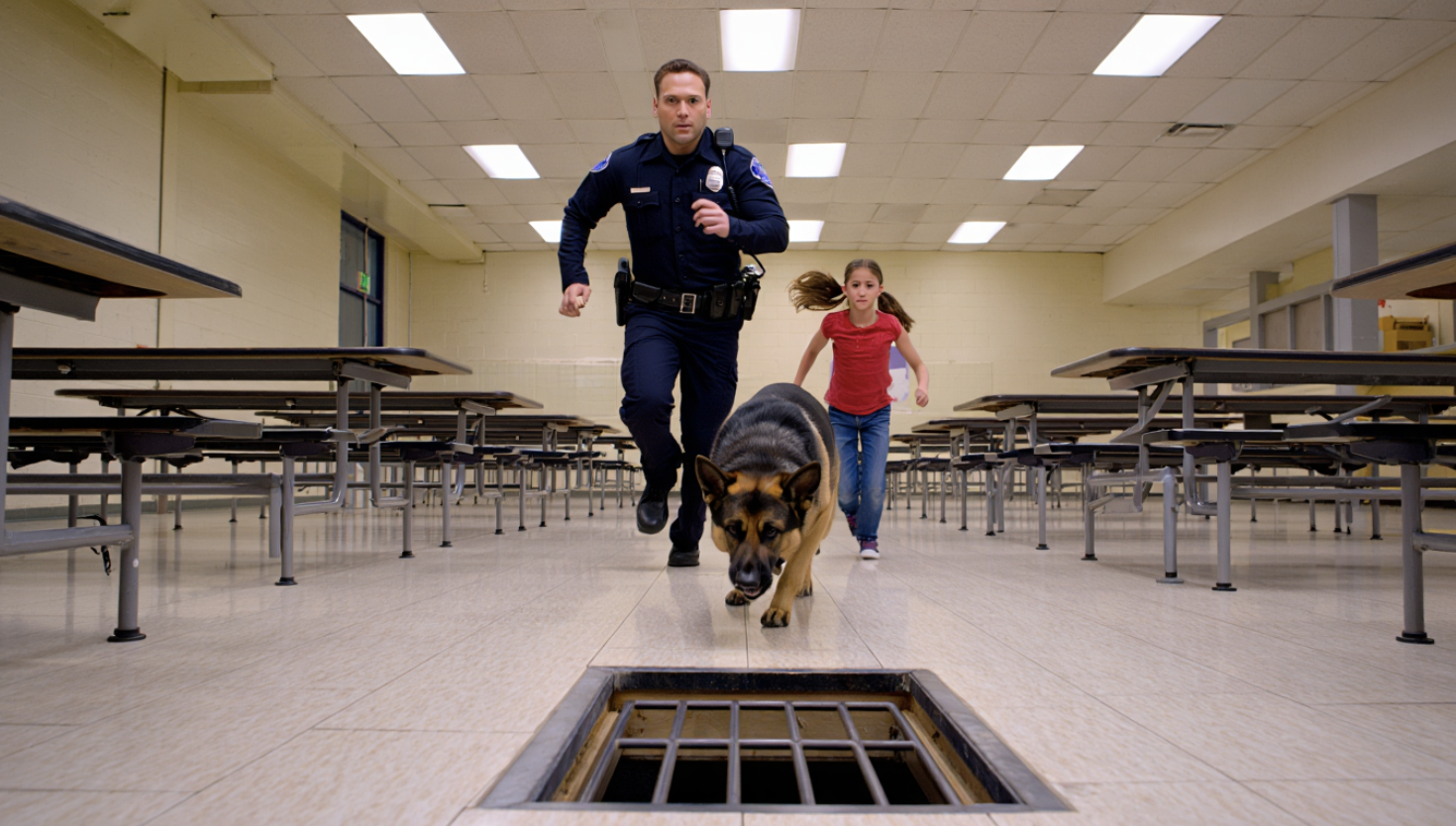
Daniels crouched beside the dog, scratching behind his ears. “Good boy,” he murmured. “You did it. You saved them all.”
But even in relief, a chill ran down Daniels’ spine. He couldn’t shake the thought that this was intentional. Someone had planted the device with a purpose. A target. And whoever had done it might still be out there, watching, waiting for the next opportunity.
Bolt sniffed the air, ears flicking, growling softly. Daniels’ gaze followed him. The cafeteria looked calm now, but his instincts screamed otherwise. He knew that this morning, bright and sunny, had been a brush with disaster. A reminder of how fragile safety could be.
“Daniels,” the squad leader said quietly, “we need to sweep the rest of the school. Check for other devices. Could be more than this one.”
Daniels nodded, heart heavy. “I’ll lead. Bolt, come on.”
Bolt bounded forward, leash taut in Ramirez’s hands. The dog’s energy was electrifying, a mix of relief and lingering tension. Daniels followed closely, glancing at the evacuated children one last time. They were safe—for now.
But Daniels knew this wasn’t over.
The school, bright and cheerful just an hour ago, had become a stark reminder: danger could hide beneath the most ordinary surfaces. And sometimes, only the most instinctive, primal senses—like Bolt’s—could reveal it.
Daniels exhaled slowly, feeling the weight of the morning press down. He patted Bolt one more time. “Good work, boy. But stay sharp. We’re not done yet.”
Bolt barked once, sharply, and Daniels understood. Danger may have been neutralized for now, but vigilance was everything.
And beneath the school’s floors, in the shadows, there might still be more waiting.
Chapter 4: Beneath the Silence
The hallway outside the cafeteria felt wrong.
Too quiet.
Too still.
The usual echo of children’s laughter had been replaced by a chilling hush that seemed to press in from the walls themselves. Lockers stood like mute witnesses. Bulletin boards fluttered faintly in the breeze of a distant open window.
Bolt’s ears twitched.
Daniels tightened his grip on the leash instinctively.
“That’s not normal…” Ramirez murmured, scanning the empty corridor.
“No,” Daniels agreed. “And neither is any of this.”
They advanced slowly, step by careful step, boots whispering across the tile. The bomb squad moved ahead in formation, sweeping each classroom door, each trash bin, each vent. The school had become a maze of hidden danger.
Bolt suddenly pulled harder on his lead.
Low growl.
Deep.
Focused.
“Another hit?” the squad leader asked, stopping.
Bolt dragged Daniels toward the science wing.
“That area was renovated last year,” the janitor muttered from behind them. “New pipes. New floor panels too.”
Daniels’ eyes narrowed. “Which means… easier to hide something.”
They reached a stretch of polished tile that looked spotless to the naked eye. No sign of disturbance. No cracks.
But Bolt was certain.
He paced in tight circles, sniffing again and again—then let out a sharp, furious bark and dug at the floor, claws scraping desperately.
“Get the scanner,” Daniels ordered.
The handheld device beeped once.
Then again.
And then it screamed.
“Dear God…” Ramirez whispered. “There’s a cavity underneath.”
The silence that followed felt heavier than any explosion ever could.
“Evacuation radius now,” the bomb squad leader barked into the radio. “We’ve got a secondary structure — unknown size.”
Daniels didn’t move.
“How much time?”
The leader’s jaw tensed. “We don’t know. That’s what scares me.”
Bolt sat suddenly. Perfectly still. Watching the floor like it was alive.
That kind of behavior meant only one thing.
“It’s not just a device,” Daniels said slowly. “It’s bigger than that.”
The team peeled back the tile—carefully, excruciatingly, like peeling skin from bone.
Underneath was not another bomb…
But a tunnel.
A narrow, reinforced shaft carved into the earth beneath the school, disappearing into darkness.
“What the hell is that doing here?” Ramirez breathed.
“Someone didn’t just plant one explosive,” Daniels muttered. “They’ve been working here for a while.”
A faint echo drifted up from below.
Footsteps.
Someone was down there.
Bolt let out a vicious snarl, hair bristling down his spine.
Daniels grabbed his flashlight. “Police! Whoever’s down there — come out NOW!”
No answer.
Only the slow, deliberate sound of someone moving away.
“He’s running,” Ramirez hissed.
“Then we’re not standing still.”
Against protocol. Against common sense. But Daniels dropped to his stomach and slid into the narrow tunnel, gun raised, flashlight cutting through the suffocating darkness.
“I’m going in,” he breathed into the comm. “Bolt stays with me.”
Bolt didn’t hesitate. The dog followed instantly, muscles coiled, breath hot against Daniels’ hand.
The tunnel opened into a small, dirt-walled chamber beneath the old boiler room. A figure stood there.
Tall.
Hooded.
Frozen by the light.
“You don’t know what you’re stopping,” the man said, voice echoing off the walls. “This place is rotten.”
“Hands up,” Daniels ordered. “Slowly.”
The man looked around frantically. “They ignored me… so I made them listen. No one ever listens until they’re afraid.”
“You threatened children,” Daniels growled.
“I tried to protect them,” the man snapped back. “From the system. From the lies. From what’s coming.”
Bolt lunged the moment the man twitched toward his pocket.
“Don’t!” Daniels roared.
But it was too late.
Bolt took him down in one clean, explosive motion, teeth clamping onto the man’s sleeve, slamming him into the dirt. The flashlight skidded, shadows jumping violently around the chamber.
The man struggled, panicked, screaming now.
“Get him off! GET HIM OFF!”
“Hold!” Daniels commanded.
Bolt froze—still pinning him, teeth bared, eyes burning.
Daniels wrenched the man’s hand free.
There was no trigger.
No detonator.
Just a torn photograph.
A picture of this same school… twenty years earlier.
And a small boy circled in red.
“Who is this?” Daniels demanded.
The man’s face twisted. Grief. Rage. Madness tangled together.
“My brother,” he whispered. “He died here. They covered it up. The pipes burst. The floor collapsed. They blamed ‘poor infrastructure’… But it was neglect. Corruption. Someone took money meant to fix it.”
His eyes lifted, wet and blazing.
“I just wanted the world to finally look down at what was buried.”
Daniels swallowed hard.
“You could’ve killed innocent kids.”
“I never meant to,” the man said, tears now mixing with dirt. “The first device was only a signal. To force an excavation. To expose it all.”
Behind them, voices echoed in the tunnel as backup arrived. Cuffs clicked around the man’s wrists. Floodlights filled the underground chamber.
The truth surfaced.
The school had been built over a sealed tragedy—a hidden collapse, buried records, forgotten victims.
And one broken man had tried to unearth it the worst way imaginable.
Hours later, as police and city officials flooded the scene, Daniels stood outside in the fading sunlight.
Children were reunited with parents. Crying. Hugging. Grateful.
Bolt sat beside him, finally calm.
A hero again.
Reporters shouted from behind barricades.
“Officer! How did you find it?”
Daniels simply looked down at the dog.
“He did,” he said. “He always does.”
He knelt, resting his forehead gently against Bolt’s.
“You listened when no one else did, boy.”
Bolt wagged his tail once, slow and proud.
Beneath them, crews would now uncover the truth, give names to the lost, and finally, finally bring light to what had been hidden.
And above, in a school that almost vanished in a single morning…
Life would begin again.
News

NBA BEN 10 — NBA YOUNGBOY’S ASSOCIATE SH0T IN HOUSTON, IN CRITICAL CONDITI0N
Rapper NBA Ben 10, an affiliate of rap superstar NBA Youngboy, was shot inside the Houston restaurant, Confessions. Rumors about the death…

POOH SHIESTY’S FATHER FACES POTENTIAL JAIL TIME — Prosecutors Claim He’s a “Flight Risk”
ATLANTA, GA – MAY 31: Pooh Shiesty attends Onyx Monday Nights at Onyx Nightclub on May 31, 2021 in Atlanta,…

UNSEEN PALACE MYSTERY — Meghan and the Queen’s Fiery Confrontation Revealed
New details have emerged about Meghan Markle’s reported tiara dispute with Queen Elizabeth II ahead of her royal wedding to…

BREAKING SH0CK — Prince Harry Handed Blunt Ultimatum by Queen Elizabeth Before Leaving the Royal Family
Prince Harry was reportedly “reluctant” to leave the royal family, but wasn’t given much choice by his grandmother, Queen Elizabeth…

6-Word Ultimatum — Prince Harry Reportedly Faces Pressure from the Firm
Prince Harry had to make a decision reluctantly. Prince Harry ‘reluctantly left’ the Royal Family, according to a historian (Image: Getty)…
🔥 ROYAL TENSION EX0SED — Kate’s Secret Moves at Prince Philip’s Funeral That Everyone Missed
It was five years ago this week that the Royal Family lost the late Duke of Edinburgh, Prince Philip – who passed away…
End of content
No more pages to load