A mother-in-law snatched custody of her grandchild to exact revenge on her daughter-in-law… but when the child learned the whole truth, the situation was completely turned around
People often say revenge ends the moment the other person begins to suffer. I believed that for many years. Looking back now, I realize revenge never truly hurts only its intended target. It spreads quietly through an entire family like a slow poison, reaching people who never deserved its consequences. I was the mother who thought she had lost her only son far too early. I was the grandmother who convinced herself she was protecting the last piece of him that remained in this world. I was also the woman who spent twenty years telling a little boy a version of the truth that slowly erased his own mother from his heart. At the time, I believed I was acting out of love. Only much later did I understand that love mixed with grief can become something frighteningly close to cruelty.
Before my son died, our family had never known real peace after his marriage. I never approved of the young woman he chose as his wife. She came from a simple background, earned an ordinary living, and spoke with a quiet confidence that I mistook for manipulation. My son insisted that she loved him for who he was rather than for the comfortable life he could provide. I smiled politely whenever he defended her, yet inside I remained convinced she had carefully planned everything. Every disagreement between them became proof in my eyes that she lacked respect. Every expensive purchase was evidence she enjoyed spending money she had never earned. Every time my son defended her, I blamed her instead of questioning my own judgment. I rarely argued openly because my son hated conflict, but my coldness never disappeared. Family dinners became exercises in forced politeness. She always treated me with respect despite the distance I deliberately created between us, and somehow that irritated me even more because I wanted her to lose patience. I wanted everyone else to see the selfish woman I believed existed beneath her calm smile. She never gave me that satisfaction.
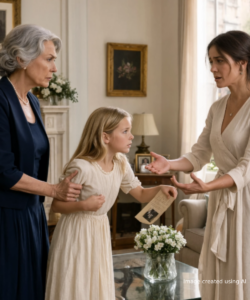
Then everything changed in a single afternoon. My son left for work exactly as he had done countless times before. A few hours later, a police officer knocked on my door. There had been a terrible accident. I barely remember the days that followed. The funeral passed like a dream filled with unfamiliar faces and endless condolences. I watched my daughter-in-law standing beside the coffin, crying until she could no longer remain on her feet. Instead of feeling compassion, I felt anger. Somewhere inside my broken heart, I irrationally believed that if she had never entered his life, perhaps fate would have chosen a different path. Grief rarely follows logic. It searches desperately for someone to blame.
The legal battle began only weeks after the funeral. My grandson was still too young to understand why everyone around him kept crying. He believed his father had simply gone on a very long trip. My daughter-in-law wanted to raise him herself, exactly as she and my son had planned. I convinced myself she was emotionally unstable and financially incapable of giving him the future he deserved. Using every legal resource available to me, I challenged her for custody. Friends testified on my behalf. Lawyers painted me as the stable grandmother with financial security, while portraying the young widow as an overwhelmed mother struggling to rebuild her life. Every tear she shed inside the courtroom somehow became another argument that she was too fragile to raise a child alone. I told myself I was protecting my grandson. Deep inside, another truth existed that I refused to acknowledge. Taking him away also allowed me to punish the woman I had never accepted as family.
The judge eventually ruled in my favor. My daughter-in-law was granted only limited visitation while I became the child’s primary guardian. I still remember the expression on her face when she kissed her little boy goodbye outside the courthouse. She promised she would never stop loving him. She promised she would come back for him one day. He cried uncontrollably while reaching toward her, unable to understand why the only person he wanted could not take him home. I carried him to my car as he screamed for his mother until exhaustion finally silenced him. That night, after he had fallen asleep with tears still drying on his cheeks, I stood beside his bed believing I had won. It would take me two decades to realize that no one truly wins when a child loses one of the people who loves him most.
The first months were the hardest. Every morning he asked when his mother would come. Every birthday he expected her to appear with a gift. Every school event he searched the crowd before quietly lowering his eyes. At first I answered honestly, telling him she loved him but needed time. Then my bitterness slowly began changing those answers. I never directly called her a bad mother, but I allowed silence to create conclusions more powerful than accusations. When she missed a visit because she had accepted extra work, I simply said, “She must have been busy.” When birthdays passed without expensive presents because she struggled financially, I reminded him that some people had different priorities. I never realized that children naturally fill empty spaces with their own fears. My carefully chosen words slowly convinced him that his mother had chosen a new life over him.
Years continued passing. My grandson grew into a disciplined young man. He excelled at school, respected his elders, and rarely caused trouble. Outwardly, our family seemed successful. Inwardly, however, I noticed something missing from him that I could never explain. He smiled politely rather than joyfully. He celebrated achievements without excitement. Every Mother’s Day at school quietly unsettled him even after he insisted it no longer mattered. Once I accidentally discovered an old drawing he had hidden inside a drawer. It showed a little boy standing between two women separated by a deep crack in the ground. On the back he had written only one sentence.
“If both love me, why couldn’t they love each other?”
I folded the paper without saying anything. That night I could not sleep.
As he entered adulthood, he gradually became more curious about the past. Questions I had successfully avoided during childhood returned with greater determination. Why had the court separated him from his mother? Why had she eventually stopped visiting? Why did every relative become uncomfortable whenever her name appeared? I repeated the same story I had told myself for years. I explained that his mother had been irresponsible, that she had eventually chosen to move on with her life, and that I had simply done what any loving grandmother would have done. He nodded politely, but I noticed something changing inside him. For the first time, he did not fully believe me.
Everything shifted unexpectedly when he inherited several old boxes stored in the attic after I decided to downsize. Among forgotten photo albums, children’s toys, and worn blankets sat a sealed envelope addressed in handwriting he had never seen before.
The front contained only five words.
“To my son, when you’re ready.”
He looked at me with confusion.
My hands began trembling.
Because I recognized the handwriting immediately.
It belonged…
to the mother he believed had abandoned him…
This article uses AI.