
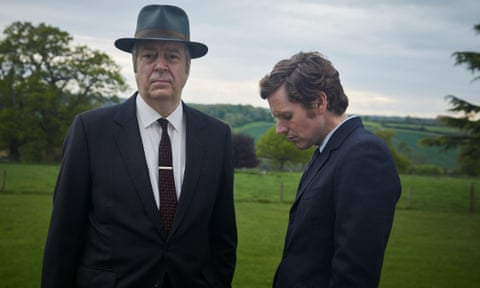
This last episode of the Inspector Morse prequel had issues to wrap up – and did it with style. From brilliantly excruciating moments to its intriguing ending, it stayed true to itself
Fans of a TV show always fear the finale will end with death. In the case of Endeavour, which has just bowed out after 11 years, we knew the police protagonist – Sgt Morse, played by Shaun Evans – must survive. He needs to hand over the role to John Thaw in Inspector Morse, which preceded Endeavour on our screens but follows it in the story of the Thames Valley detective created by Colin Dexter.
The death of at least one other character was expected, though, with Morse’s boss and mentor, Roger Allam’s DCI Fred Thursday, the biggest worry. The writer of all 36 episodes, Russell Lewis, acknowledged that the real challenge of the last Endeavour was to explain why, in the 33 episodes of Morse, he never once mentions Thursday. (The logical reason is that the earlier years were written later, but Lewis had to make this psychologically plausible.)
Endeavour’s final episode teased viewers’ fears by starting with a funeral, corpse unspecified. Might everything flashback from Thursday’s interment? But that body turned out not to be his, and neither did a second one. The story – so full of morbid foreshadowing it might have been sponsored by Dignitas – saw Morse and Thursday trade lines about “taking secrets to the grave” and “having a death wish”. A subplot involved death notices in the Oxford Mail, sometimes for people still alive.
Several Funerals and a Wedding might have been the subtitle of this script in which Morse had to watch the woman he loved, but sacrificed for work – Thursday’s daughter Joan – marry oafish Oxford copper Jim Strange. Further tortured by serving as Strange’s best man, in a brilliantly excruciating scene, he had to stand in as groom at a church rehearsal when Strange was late.
So, having explained Morse’s later life as an embittered bachelor, the episode had to settle why he ceased to speak of Thursday. Screenwriter Lewis included lots of neat quotations from the franchise: the young copper singing in a choir matched a scene in the first Inspector Morse, a shot of the officer in a hospital bed shadowed one in the final Morse. But the most significant references were in Latin: a touching double tribute to Dexter, a former classics master, and Morse, who had his own passion for ancient languages. Latin phrases appeared on each menacing obituary announcement. “Death has come with a new terror!” Morse translated for less educated colleagues.
The episode’s title, Exeunt, is the classical end-of-scene direction that means: “They all leave the stage.” While mentions of opera, a Morse passion, have filled Endeavour, the key references at the last were theatrical. Lewis made devastating use of the brutal lines from Shakespeare’s Henry IV Part II, when the newly crowned Henry V dismisses his former mentor Falstaff: “I know thee not, old man.” Those words from Morse to Thursday marked the rupture between them that had been building in these final episodes due to the older copper’s involvement with some corrupt policemen.
Another theatrical allusion was to Chekhov’s rule that, if the audience is shown a rifle, it must be fired before the curtain. In separate scenes, Thursday was shown taking a gun from a cupboard at home and a drawer in his office. Was it the same weapon, or were there two? That question is key to a highly ambiguous ending that seemed designed to drive online speculation.
In their final scene together, Thursday gives Morse a gun, implicitly to protect himself from the bent coppers. Morse is then shown sitting on a churchyard bench with a firearm. When he’s off camera, a shot goes off.
This climax raises various possibilities. The most extreme theory is that Morse has shot himself, although this would mean either a) the whole of Morse took place in some temporal limbo, or b) Morse survived the suicide attempt but required such radical facial reconstruction that, by 1987, he looked like John Thaw. If there were two guns, then Thursday, having disgraced his profession, possibly turned the second on himself, the resulting guilt causing the lead character’s melancholy alcoholism in Inspector Morse.
The best bet seems that Morse, having lost his love and his favourite colleague, contemplated putting the End into Endeavour but chose life instead, with the added poignancy that, very unusually, viewers know what happens to him next: the pains carrying on will bring.
News

Netflix’s New Mystery Thr=i=ller Sh0cks Viewers: A Father’s Desperate Search for His Missing Daughter Unleashes Dark Family Secrets
Netflix viewers who tuned into Run Away, the eight-part mystery thriller starring Gavin & Stacey‘s Ruth Jones and Midsomer Murders‘ Annette Badland, are hooked after…
A Night That Changed Late-Night Forever: Richard Pryor, Tim Conway, and the Tonight Show Meltdown Fans Still Rewatch Today
Television talk shows are often a predictable experience. Guests come in with prepared talking points, polished answers, and sometimes a…

“Behind Closed Doors”: Eric Dane’s ALS Battle Pushes His Family to the Breaking Point
Grey’s Anatomy actor Eric Dane now requires full time care for ALS as ex details fight for support The actor…

A Quiet “Masterpiece”: The Netflix Series Viewers Start Casually — Then Can’t Stop Watching
The 100% rated limited series is labelled as ‘so binge-worthy’ La Palma: Netflix disaster film teased in official trailer A…
“I Think My Horse Is Shrinking” — How Doing Nothing Created One of TV’s Funniest Meltdowns
It began like any other night on The Tonight Show. The band played its familiar theme, the curtain shimmered open, and…

The Tiger of Malaysia Roars Back: Fan-Favorite Pirate Epic Finally Lands on Netflix US
Netflix US has secured the rights to one of the most anticipated international productions of the year. The epic swashbuckling drama Sandokan,…
End of content
No more pages to load