“I’ll Take the Ugly Sister.” The Ruthless Mafia Boss Shocked Everyone with His Choice
“I’ll Take The Ugly Sister.” The Ruthless Mafia Boss Left The Entire Room Speechless
He smelled of cold iron and something chemical underneath — not cologne, not soap, something industrial and exact — and he had been in the room for less than thirty seconds before every other person in it seemed to shrink by half.
Mireille Voss had been practicing invisibility her whole life. She was very good at it.
She was wedged into the wing-back chair at the far end of the receiving room, the one her father used for meetings he didn’t want to happen, with her knees pressed together and her sketchbook on her lap and her coat pulled shut despite the fact that the room wasn’t cold. She had positioned herself carefully: behind the floor lamp, partially behind the curtain, in the shadow that fell between two loaded bookshelves that nobody ever actually used. She had a theory that if she held perfectly still and thought very quiet thoughts, she could reduce herself to something indistinguishable from furniture.
The theory had failed her at school. It had failed her at every family gathering since she was fourteen and the fire happened. But her father still kept trying to use her as a piece of the room’s scenery, and she kept trying to comply because the alternative was being noticed.
Being noticed, in this family, had never been good for her.
“He’ll be here at half past,” her father, Edmund, said to the middle distance, checking his watch. His voice had gone to that particular frequency she associated with catastrophic debt — a high, tight sound, as if someone had wound a key in his throat too many times and the spring was about to snap. “I know what I’m doing. It’s fine. It’s absolutely going to be fine.”
He was not fine. He had not been fine for approximately three years, which was how long it had taken him to build a gambling debt substantial enough to summon this particular appointment.
Beside him on the settee, her sister Margaux smoothed the skirt of her emerald dress and tilted her chin at an angle that had never once been accidental. Margaux was twenty-one and beautiful with the kind of precision that required maintenance — the waves in her blonde hair, the particular shade of her lips, the dress that had no business being worn on a Tuesday afternoon unless the Tuesday afternoon was auditioning for something.
Margaux knew why she was here. She had dressed for the role. She ran one finger along the neckline of her dress and glanced at the door with the composed expression of someone waiting for applause.
Mireille looked back down at her sketchbook. She was working on the hands. The wood of the chair arm was gouged in two places by previous upholstery nails, and she had been trying to capture the exact way the gouge caught the afternoon light. There was something about the specific angle of damage that interested her — the way wear made a thing more itself.
The door opened.
Edmund dropped his glass.
Mireille kept her eyes on the gouged wood, but her pencil stopped moving.
One set of footsteps. Just one.
She had expected several — men who moved in packs usually brought their pack — but there was only the single, unhurried rhythm of someone who had never needed backup to fill a room.
Edmund made a sound. Then: “Mr. Solvay. Thank you — thank you for coming.”
Silence.
“The debt is four million,” said a voice. Not raised. Not cruel, particularly. Just flat, in the manner of a man stating altitude or temperature. Something factual. “Past due.”
“I know, I understand, the market has been —”
“I don’t care about the market.”
Mireille heard her father’s negotiation collapse in the gap that followed. She heard him pivot to the arrangement he’d prepared: the name he had for it was alliance, which was his way of not saying sale. She heard Margaux being introduced, heard the slight catch in Edmund’s voice that meant the words were coming out wrong because he needed them to go right.
She kept her pencil still.
She did not look up.
What she heard next was silence, and then Margaux’s practiced exhale, the one that was technically a breath but functioned as a performance. And then more silence, which was the wrong kind — not the silence of a man considering, but the silence of a man who had already moved on.
“No.”
One word.
Mireille looked up.
She did it involuntarily, the way you look toward a sound you weren’t expecting. The man standing in the center of her father’s receiving room was broad across the shoulders in a way that spoke of actual use rather than construction. His coat was dark and damp from the outside rain. His face was not what she would have called handsome — his nose had been broken and reset at an angle, his jaw was too heavy, the lines around his eyes were not from smiling — but it was a face that had clearly decided some time ago that it did not require anyone’s approval and had settled into itself accordingly.
He was staring at Margaux with the absolute disinterest of a man looking at a piece of furniture in the wrong style.
“No?” Edmund repeated. The word came out as a separate, baffled object. “I don’t — Mr. Solvay, perhaps I haven’t explained — she’s —”
“She’s loud,” the man said.
“She hasn’t said a word.”
“The dress is loud. The perfume is loud.” He turned from Margaux the way you turn from a lamp you’ve decided isn’t bright enough. His eyes tracked the room methodically — not looking for something beautiful, looking for something true. He covered the curtains, the bookshelves, the far corner.
Mireille had time to think I am a lamp, I am a side table, I am nothing notable and then his eyes found her.
She did not move. This was the mistake — she had trained herself so thoroughly to go still when threatened that her body obeyed the instinct before her mind could override it, and stillness, in this case, was the opposite of invisible. It made her look like an animal that had just been spotted.
He tilted his head. Took one step. Two.
Her elbow slipped off the armrest. She grabbed for the reading lamp beside her — caught it — knocked her pencil to the floor — watched her sketchbook slide off her knees. She scrambled for it with both hands, her hair falling forward, her glasses sliding down her nose, and when she looked up, breathing harder than she should have been, he was standing four feet away, looking down at her with an expression she could not read.
He looked at her hands first. The charcoal on her fingers, the pencil she’d retrieved from the floor. Then he looked at the scar.
He did not look away.
This was the thing that always happened, and the way it happened mattered enormously. People looked at the scar either briefly and then looked anywhere else, which meant disgust softened into politeness, or they stared with the particular intensity of someone trying to solve it, which meant they were making her into a problem to be understood. This man did neither. He looked at it the way he had looked at everything else in the room — like information.
She glared at him. She did not mean to do it, but the heat of being studied like a specimen she had been fielding since she was fourteen rose in her without her permission, and her chin came up, and she glared.
Something shifted in his face. A muscle in his jaw, a slight adjustment around his eyes.
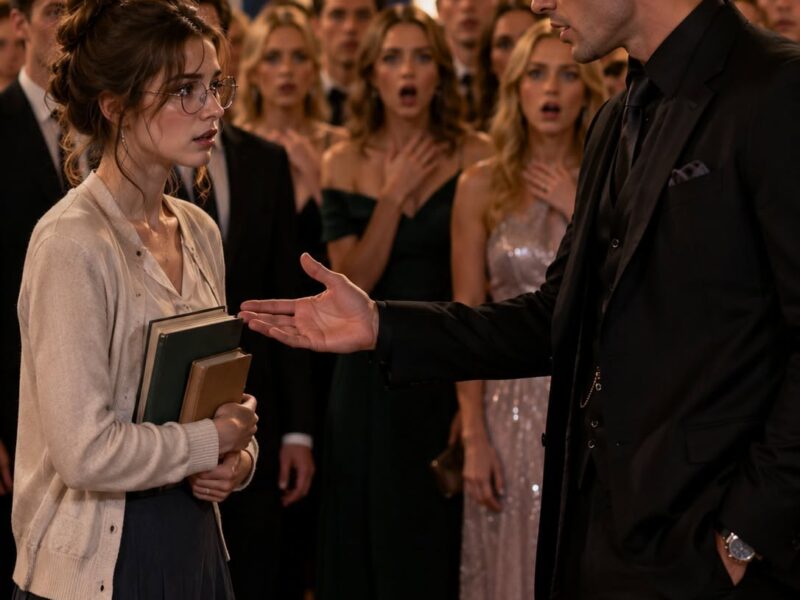
“Her,” he said. He didn’t turn around. He said it to the room with his eyes still on hers. “I’ll take her.”
“Mireille?” Her father’s voice went high enough to fracture. “No, no — Mr. Solvay, she’s — that’s Mireille. She’s not — she’s the other one. She’s not suitable. She doesn’t go out, she doesn’t —”
“She doesn’t pretend to be a decoration,” the man said. “That’s sufficient.”
Edmund took two steps forward, his voice climbing toward something close to hysteria. “Her face, Mr. Solvay, the accident, she’s —”
The man turned. It was not a fast movement, but something in its quality made Edmund stop walking.
“Did I ask for a list of her defects?” His voice hadn’t risen at all, but the temperature in it had changed. “I said I’ll take her. Are you refusing my terms?”
“No,” Edmund said immediately. “No, of course not.”
“Good.”
He turned back to her.
Mireille had pushed her glasses up her nose and was sitting very straight in the wing-back chair with her sketchbook clutched to her chest and her jaw set. She was aware that she looked like someone who had been told something impossible and had decided the only available response was dignity.
“Can you walk?” he asked. It was such a practical question that it took her a second to process it.
“Yes,” she said.
“Coat?”
“Upstairs.”
“Pack what you need. Ten minutes.” He checked a watch — not expensive, black, functional — and looked back at her. “Nine and a half, now.”
PART 2
Her room was on the top floor. It had been the maid’s quarters before the maid left and Edmund stopped replacing the staff he couldn’t pay. Mireille took the stairs two at a time, not from urgency but from the habit of moving fast through the upper floors because the attic was cold and forward momentum kept you from thinking about the cold.
She did not turn on the overhead light. The skylight was enough.
She pulled her canvas bag from under the cot — she had owned it since university, it had paint on one strap and a broken zipper on the front pocket — and unzipped it with hands that shook enough to catch the zipper twice on the fabric.
She was not under any illusions about what was happening. She had read the papers, when she could get them, and she had a working understanding of who Aleksander Solvay was and what his family controlled in this part of the city. The docks were his. The zoning commission did what he told them. He needed her father’s political capital — such as it was, which was diminishing — to push a rezoning through, and he needed insurance against her father betraying him to the prosecutor’s office afterward.
She was the insurance. Cheap, low-maintenance, unlikely to cause complications. He had chosen her because she was the path of least resistance, and she knew this, and she was not going to pretend otherwise.
She threw in socks. Two sweaters. Her second pair of jeans. She wrapped her roll of charcoal pencils in a shirt and tucked it in beside her sketchbook.
The door banged open.
Margaux stood in the frame wearing the emerald dress like an accusation.
“How did you do it?” Her mascara had run. She hadn’t fixed it. In fifteen years, Mireille had never seen Margaux not fix her mascara. “Tell me how you did it. Did you speak to him beforehand? Did you —”