My Brother Framed Me and Sent Me to Prison… Four Years Later, He Didn’t Recognize the Woman I Became
My Own Brother Sent Me To Prison—Four Years Later, I Walked Past Him Like He Was A Stranger.
My own brother put me in prison.
Four years later, on the day I was released, I walked past him as though he were a stranger.
During my final year behind bars, the prison doctor placed a medical file in front of me.
The diagnosis was written in cold black letters.
Stage-four lung cancer.
Six months.
That was how long the specialist believed I had left.
On the morning of my release, three black SUVs waited outside the prison gates.
My brother stood beside the first one.
I never looked at him.
Before I left, my cellmate, Rosa, held my hand.
“Your brother may have sent you here,” she said, “but he also filed the petition that got your sentence reduced.”
I said nothing.
“You don’t have much time, Anna. Sit down with him. Hear him out.”
I gave her a small nod.
Then I stepped through the gate and deliberately walked in the opposite direction.
Four years earlier, during the worst snowstorm Boston had seen in a decade, I had knelt outside my brother’s house for three days.
I begged him to reopen the investigation.
Just once.
I told him I had not stolen the research.
I told him I had not caused the laboratory fire.
I told him the evidence had been planted.
He did not believe me.
He believed our adopted sister, Evelyn.
Then he personally handed the evidence to prosecutors.
Because of those four years in prison, I lost the best window for treatment.
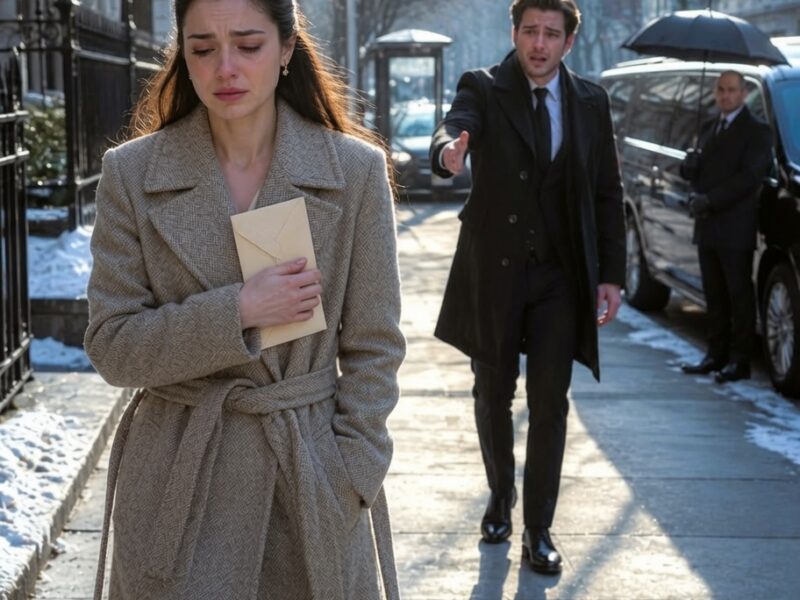
Behind me, my brother’s voice broke through the freezing air.
“Anna, do you hate me so much you won’t even speak?”
I did not turn around.
I did not slow down.
The doctor said I had six months.
That was too little time to spend hating anyone.
I had only one thing left to do.
Find Professor Helen Hart.
And tell her that the faith she once placed in me had not been a mistake.
The iron gate closed behind me with a heavy metallic crash.
The sunlight outside was painfully bright.
After four years beneath fluorescent lights and concrete ceilings, my eyes could barely adjust.
When my vision finally cleared, I saw the three black SUVs.
The license plates belonged to Hawthorne Group.
My family’s company.
The door of the first SUV opened.
A man stepped out.
Julian Hawthorne.
My older brother.
Four years had changed him.
His cheeks were hollow.
Dark circles marked his eyes.
A rough shadow covered his jaw.
He wore an old black coat.
I recognized it immediately.
I had chosen it for his birthday five years earlier.
Julian stood beside the vehicle as if he had forgotten how to move.
The moment he saw me, his entire body went rigid.
His eyes turned red.
“Anna.”
His voice sounded scraped raw.
I looked away.
No answer.
No hesitation.
I walked toward the bus stop at the far end of the road.
Julian recovered after several seconds and hurried after me.
He stepped into my path.
“Come home with me.”
I moved to the left.
He moved with me.
I tried the right.
He blocked me again.
Only then did I stop.
“Move.”
The word was quiet.
No anger.
No grief.
No accusation.
Prison had taught me to bury emotion where no one could use it against me.
Julian swayed as though the single word had struck him physically.
“Anna, please let me explain.”
“Mr. Hawthorne.”
I looked directly at him for the first time.
The formal name made his pupils contract.
“There is nothing left between us that needs explaining.”
I stepped around him.
My shoulder brushed his coat.
This time, he did not stop me.
He remained in the middle of the road like a tree split by lightning.
At the bus stop, I reached into my coat pocket.
I had two hundred dollars.
The women in my unit had collected it without telling me.
Beside the money was a folded piece of paper.
On it was one address:
St. Matthew’s Public Hospital
Oncology Department
Professor Helen Hart
I tightened my fingers around the note.
The bus arrived.
I sat in the last row beside the window.
As it pulled away, I saw Julian still standing outside the prison.
His assistant approached with an umbrella.
Julian shoved it aside.
The wind lifted the edge of his black coat.
He looked smaller than I remembered.
I turned away.
The pain in my chest spread slowly beneath my ribs.
It had nothing to do with Julian.
It was only the cancer reminding me that time was moving.
The bus took forty minutes to reach St. Matthew’s.
The hospital was old.
Its white exterior had faded to yellow.
The waiting room smelled of antiseptic and instant coffee.
It was nothing like the private medical centers owned by Hawthorne Group.
I checked in at oncology and sat on a cracked plastic chair.
Beside me, an elderly woman wore a scarf around her bald head.
The backs of her hands were covered in needle marks.
She smiled.
“First treatment?”
“No.”
“Consultation?”
“I’m looking for someone.”
“Doctor?”
“Professor Helen Hart.”
The woman’s smile faded.
“Helen Hart?”
“Yes.”
She looked at me carefully.
“Honey, Professor Hart hasn’t worked here in three years.”
My heart sank.
“Do you know where she went?”
“No one does.”
Before I could ask more, a nurse called my name.
“Anna Hawthorne?”
Several people turned.
The name still meant something in Boston.
I stood.
The nurse led me into an examination room.
A young oncologist entered carrying my prison records.
“Ms. Hawthorne, I’m Dr. Samuel Reed.”
He sat across from me.
“I’ve reviewed your scans.”
“How long?”
He hesitated.
“Without treatment, perhaps three to six months.”
“And with treatment?”
“We may be able to extend that. But the cancer has spread.”
“To where?”
“Your liver. Several lymph nodes. There is also a lesion near the spine.”
I nodded.
The information felt distant.
Like weather in another city.
Dr. Reed studied me.
“You don’t seem surprised.”
“I had three months to get used to it.”
“Your family has access to excellent private care.”
“My family has nothing to do with me.”
His eyes shifted.
“Your brother has already contacted the hospital.”
My expression hardened.
“What did he say?”
“He offered to transfer you to Hawthorne Medical Center.”
“No.”
“He also requested to be listed as your emergency contact.”
“No.”
“Ms. Hawthorne—”
“I said no.”
Dr. Reed closed the file.
“You have the right to refuse.”
“Thank you.”
“But you should understand that advanced treatment will be expensive.”
I placed the two hundred dollars on my lap.
“How expensive?”
He did not answer directly.
That was answer enough.
I looked toward the window.
“Do you know Professor Hart?”
His expression changed.
“Why are you looking for her?”
“She was my mentor.”
“She was also the director of the Hawthorne Biomedical Research Institute.”
“Before I destroyed her career.”
“You were convicted of stealing research data and causing the laboratory fire.”
“I know what I was convicted of.”
Dr. Reed leaned back.
“What are you saying?”
“I didn’t do it.”
The door opened before he could respond.
Julian stood outside.
He had followed me.
His face tightened when he saw the money in my hands.
“Anna.”
I stood.
“How did you find me?”
“You used your name at registration.”
“I’ll correct that next time.”
He stepped inside.
“I have specialists waiting at Hawthorne Medical.”
“I’m not going.”
“They have access to clinical trials.”
“No.”
“You could die.”
“I know.”
The words stopped him.
His eyes filled with something I refused to examine.
“Then why are you doing this?”
“I need to find Professor Hart.”
Julian went pale.
“Why?”
“To tell her the truth.”
He looked at Dr. Reed.
“Leave us.”
Dr. Reed did not move.
“This is my examination room.”
Julian’s old authority returned for one second.
Then he seemed to remember he no longer controlled every room I entered.
“Please,” he said.
Dr. Reed looked at me.
I nodded.
When the door closed, Julian stood between me and the exit.
“Professor Hart is gone.”
“Where?”
“I don’t know.”
“You expect me to believe that?”
“She disappeared after the institute closed.”
“The institute didn’t close. You sold it.”
His jaw tightened.
“I was trying to save the company.”
“You saved the company by sacrificing me.”
“I believed the evidence.”
“You chose the evidence that protected Evelyn.”
He looked down.
“I was wrong.”
Four years.
One sentence.
I should have felt vindicated.
I felt tired.
“When did you realize?”
“Eight months ago.”
My fingers went cold.
“You knew eight months ago?”
“I found financial transfers linked to Evelyn.”
“And you left me in prison?”
“I filed immediately to reopen the case.”
“Eight months.”
“The prosecutors resisted.”
“You own half the hospitals in the state.”
“I don’t own the courts.”
“No. But you once owned enough influence to put me there.”
He flinched.
“Anna, I spent every day trying to undo it.”
“I spent every day living it.”
His mouth opened.
Nothing came out.
I stepped past him.
He caught my sleeve, then released it before touching my skin.
“Professor Hart may be dead.”
I stopped.
“What?”
“She vanished after receiving threats.”
“From whom?”
“I don’t know.”
“You never know anything until it is too late.”
His face broke.
“I know.”
I left the room.
At the end of the corridor, the elderly woman with the headscarf waited beside the elevator.
She looked at Julian.
Then at me.
When the doors opened, she stepped inside with me.
Julian followed.
The woman pressed the lobby button.
Then she whispered without turning her head:
“If you’re really Professor Hart’s student, don’t go back to your brother’s house.”
I looked at her.
She kept her eyes on the closing doors.
“Why?”
“Because the woman who framed you still lives there.”
Her name was Margaret Bell.
She had been a laboratory technician at the Hawthorne Institute.
And she knew more about the fire than she had ever told police.
We left the hospital through a side entrance.
Julian’s security team waited near the main lobby, but Margaret led me through the laundry exit.
Outside, she climbed into an old blue sedan.
“Get in.”
I hesitated.
“You don’t know me.”
“I know enough.”
“Why didn’t you testify four years ago?”
Fear moved across her face.
“Because they threatened my daughter.”
I got into the car.
Margaret drove three blocks before speaking again.
“The night of the fire, you weren’t the last person in Professor Hart’s laboratory.”
“I know.”
“Evelyn was.”
My hands tightened.
“Did you see her?”
“Yes.”
“Then why did the cameras show me?”
“The footage was altered.”
“By whom?”
“Your brother’s security director.”
“Marcus Vale?”
She nodded.
Marcus had worked for our family for twenty years.
He taught Julian and me how to drive.
He attended my high-school graduation.
“He changed the footage for Evelyn?”
“He did more than that.”
Margaret pulled into an empty parking lot and opened the glove compartment.
Inside was an envelope.
She handed me a photograph.
It showed Evelyn entering the restricted wing at 11:42 p.m.
The fire started at 12:18.
The official footage showed me entering at 11:45.
“Why keep this?”
“Professor Hart told me to.”
My breath caught.
“She knew?”
“She suspected.”
“Where is she?”
Margaret looked toward the rearview mirror.
A black SUV had turned into the lot.
“She’s alive.”
My heart began pounding.
“Where?”
“She told me to bring you if you ever came looking.”
The SUV accelerated toward us.
Margaret started the engine.
“But first,” she said, “we have to survive the people who made sure you went to prison.”
The black SUV struck the rear of Margaret’s sedan before we reached the street.
The impact threw me forward.
My seat belt locked across my chest.
Pain exploded beneath my ribs.
Margaret cursed and turned sharply into an alley.
The SUV followed.
“Who are they?” I asked.
“The same people who followed Professor Hart.”
“Does Julian know?”
“I don’t know who Julian knows anymore.”
The sedan bounced over a pothole.
My lungs burned.
I coughed into my sleeve.
When I lowered it, blood marked the fabric.
Margaret saw it.
“You really are sick.”
“Keep driving.”
She took three rapid turns, entered a public garage, and pulled between two delivery vans.
The SUV passed the entrance.
Margaret shut off the engine.
For several seconds, neither of us moved.
Then she looked at the blood on my sleeve.
“Professor Hart has been waiting four years to clear your name.”
“She shouldn’t have waited.”
“She didn’t.”
“What does that mean?”
“She sent evidence to your brother.”
“When?”
“Three years ago.”
The garage seemed to go silent.
“Julian received evidence?”
“I watched her mail it.”
“Did he respond?”
“No.”
My mind returned to the prison gate.
His hollow face.
His claim that he learned the truth eight months earlier.
Either Margaret was wrong.
Or Julian had lied again.
“What evidence?”
“Original lab records. Security logs. A copy of the patent registry.”
“Where is Professor Hart now?”
“Vermont.”
“Take me there.”
“You need a hospital.”
“I need the truth.”
“You could collapse on the road.”
“Then drive quickly.”
Margaret looked at me for a long time.
Then started the engine.
Professor Hart lived in a cottage outside a small mountain town.
The journey took four hours.
By the time we arrived, darkness had fallen.
Margaret knocked in a precise pattern.
Three times.
Pause.
Twice.
The door opened.
Helen Hart stood before me.
She had aged.
Her hair was white.
A scar crossed the left side of her face and disappeared beneath her collar.
But her eyes were the same.
Clear.
Sharp.
Uncompromising.
For one second, neither of us spoke.
Then she touched my cheek.
“My brilliant girl.”
The words undid me.
I had survived prison without crying in front of guards.
I had received a terminal diagnosis without tears.
But when Professor Hart looked at me with the same faith she had shown four years earlier, my knees weakened.
“I didn’t steal it,” I whispered.
“I know.”
“I didn’t start the fire.”
“I know.”
“I tried to tell them.”
“I know.”
She pulled me into her arms.
I wept against her shoulder like the twenty-four-year-old student I had been before everything disappeared.
When the tears finally stopped, she led us inside.
The cottage walls were covered with medical journals and handwritten diagrams.
A portable oxygen tank stood beside the desk.
“You’re ill,” I said.
“So are you.”
Margaret quietly left us alone.
Professor Hart poured tea.
“How long?”
“Six months.”
Her hand stopped.
“What kind?”
“Lung cancer.”
“Genetic profile?”
“I don’t know.”
“Biopsy?”
“Prison hospital.”
She held out her hand.
I gave her the records.
She read every page.
Her expression changed.
“These results make no sense.”
“The cancer has spread.”
“I can see that.”
She looked closer.
“But the mutation profile resembles exposure-linked carcinoma.”
“Meaning?”
“This may not be ordinary lung cancer.”
She pulled out an old file.
“Our research involved an aerosolized delivery compound.”
I remembered.
Project Helix.
A targeted treatment designed to carry gene therapy directly into diseased lung tissue.
The laboratory fire destroyed the prototype.
At least, that was what the public believed.
Professor Hart opened a photograph.
“Evelyn stole the compound.”
“Why?”
“To sell it.”
“To whom?”
“A private defense contractor called Asterion.”
My skin went cold.
Helix could carry treatment.
It could also carry toxins.
Asterion wanted military applications.
Professor Hart continued.
“The fire was intended to erase the theft. But the compound was released into the ventilation system.”
“I was in the building that week.”
“Yes.”
“So was everyone else.”
“Most people received low exposure.”
“Why me?”
She looked at my prison medical records.
“Because someone continued exposing you after your arrest.”
I stared at her.
“That’s impossible.”
“Were you given respiratory treatments?”
“Yes.”
“By whom?”
“The prison clinic.”
“What medication?”
“I never asked.”
Professor Hart closed the file.
“Anna, your cancer may have been induced.”
The room tilted.
“Someone poisoned me in prison?”
“Possibly.”
“Why?”
“To ensure you never lived long enough to clear your name.”
Professor Hart had preserved evidence from the night of the fire.
Original server logs.
Patent drafts.
Audio recordings.
And a video captured by an independent laboratory camera Marcus did not know existed.
The footage showed Evelyn entering the lab with a silver case.
Twenty minutes later, Marcus joined her.
They removed three vials from the secure freezer.
Then Evelyn poured accelerant across the storage room.
Before leaving, she placed my security badge near the door.
It was not merely enough to clear me.
It proved conspiracy.
“Why didn’t this reach the police?” I asked.
“It did.”
“When?”
“Three years ago.”
She opened a folder containing shipping records.
The package had been delivered to Julian’s office.
Signed for by his chief of staff.
“Julian said he learned the truth eight months ago.”
“Then someone intercepted it.”
“Or he buried it.”
Professor Hart’s expression softened.
“Do you believe your brother capable of that?”
Four years ago, I would have said no.
Then he sent me to prison.
“I don’t know.”
My phone rang.
Julian.
I almost ignored it.
Professor Hart said, “Answer.”
I put the call on speaker.
“Anna, where are you?”
“Safe.”
“You left the hospital with Margaret Bell.”
“How do you know?”
“I’ve been looking for her.”
“Why?”
“She contacted my office three years ago and disappeared.”
I looked at Professor Hart.
“Did you receive a package from Professor Hart?”
Silence.
“Julian.”
“Yes.”
My breath stopped.
“You received it?”
“Not personally.”
“What happened?”
“My chief of staff logged it. The package vanished before I saw it.”
“Who was your chief of staff?”
Another silence.
Then he answered.
“Evelyn.”
Of course.
Our adopted sister had managed Julian’s schedule, correspondence, and private records after I went to prison.
She had stood beside him at every court appearance.
She cried in the courtroom when I was sentenced.
She moved into the family home three months later.
“She intercepted the evidence,” I said.
“I believe so.”
“And you never questioned why Professor Hart vanished?”
“I did. Marcus said she fled because she was guilty.”
“You believed Marcus too.”
His voice cracked.
“Yes.”
Professor Hart leaned toward the phone.
“Julian.”
He stopped breathing.
“Professor Hart?”
“You failed your sister.”
“I know.”
“No. You know you made an error.”
Her voice sharpened.
“You do not yet understand failure.”
He said nothing.
“Anna begged you to investigate. You chose convenience over doubt. Authority over love. You handed your sister to a system you knew could destroy her.”
“I know.”
“You keep saying that.”
Professor Hart looked at me.
“But knowledge without action is only another form of cowardice.”
Julian’s breathing became uneven.
“What do you need me to do?”
I spoke before Professor Hart could answer.
“Find out who approved my prison treatments.”
“I already have.”
My blood chilled.
“Who?”
“The clinic orders came from a private physician.”
“Name.”
Julian whispered it.
“Dr. Evelyn Hawthorne.”
Evelyn had earned a medical degree before joining the family company.
She no longer practiced, but her license remained active.
During my imprisonment, she had signed quarterly authorization forms for a respiratory trial administered through the prison clinic.
The program was supposedly intended to treat chronic asthma.
I had never had asthma.
The records listed me under another inmate’s diagnosis.
Evelyn had visited the prison six times.
I never saw her.
She met privately with the medical director.
Julian sent the documents to Professor Hart.
She reviewed them in silence.
Then she pointed to the compound code.
“HX-17.”
“What is it?” Julian asked over the video call.
“A degraded Helix carrier.”
“Could it cause cancer?”
“With repeated exposure, yes.”
Julian closed his eyes.
His face drained of color.
“She poisoned Anna.”
Professor Hart corrected him.
“She likely attempted to accelerate cellular damage. Whether the terminal cancer was intentional will require evidence.”
Julian opened his eyes.
“What treatment does Anna need?”
“First, a full molecular profile.”
“I’ll send a helicopter.”
“No,” I said.
“Anna—”
“No Hawthorne hospital.”
“This is not the time to punish me.”
“I’m not punishing you. I do not trust your systems.”
He looked as if I had struck him.
Professor Hart nodded.
“She is right.”
“I can secure an independent facility.”
“You will fund it anonymously,” Professor Hart said. “You will receive no medical authority. Anna decides who sees her records.”
Julian swallowed.
“Agreed.”
“No,” I said again.
Everyone looked at me.
“I don’t want his money.”
Professor Hart sat beside me.
“Pride is useful when it protects dignity. Less useful when it kills you.”
“I’m already dying.”
“Perhaps.”
She tapped the prison report.
“But this diagnosis was made by people connected to Evelyn.”
I stared at her.
“You think it could be wrong?”
“I think it may be incomplete.”
She looked toward the old research files.
“And if Helix caused this, Helix may also offer a way to slow it.”
The next morning, Professor Hart arranged testing at an independent cancer institute in New Hampshire.
Julian paid through a legal trust that did not give him access to my records.
He arrived outside the facility and remained in the parking lot.
I refused to see him.
He stayed anyway.
For three days.
The biopsy showed a rare engineered mutation pattern.
The cancer was real.
It had spread.
But Professor Hart found something the prison doctors had missed.
The tumor cells carried a receptor designed for the original Helix treatment.
The compound that had caused the damage had also left behind a potential target.
“There is an experimental therapy,” she said.
“Has it been tested?”
“In animals.”
“Humans?”
“No.”
“What are the odds?”
She did not soften the truth.
“You may die from the treatment.”
“And without it?”
“Months.”
I signed the consent form.
Julian learned about the trial through Miriam, the independent attorney Professor Hart had appointed.
He demanded to speak with me.
I finally agreed.
We met in a consultation room.
He looked worse than he had outside the prison.
“You can’t do this,” he said.
“I can.”
“It has never been tested.”
“Neither was the poison.”
His face twisted.
“Please don’t call it that.”
“What would you prefer?”
He sat across from me.
“I found proof that Evelyn ordered the treatments.”
“I know.”
“I also found bank transfers from Asterion.”
“To her?”
“To Marcus. Then to shell companies she controlled.”
“Give everything to federal investigators.”
“I already did.”
“Good.”
He looked at me.
“That’s all?”
“What else do you want?”
“For you to let me help.”
“You are helping.”
“No.”
His voice broke.
“I want to sit beside you.”
I looked toward the window.
Four years earlier, I would have given anything for him to sit beside me.
Now the desire felt like a memory belonging to someone else.
“Why did you believe her?” I asked.
Julian lowered his head.
“Because the evidence was overwhelming.”
“That is not what I asked.”
He was silent.
“Why did you believe Evelyn over me?”
His hands tightened.
“Because she needed me.”
I stared at him.
“You didn’t?”
“No.”
A bitter smile touched his face.
“You were always brilliant. Independent. Difficult to protect.”
“And Evelyn was fragile.”
“She made me feel responsible.”
“So when she cried and I fought, you chose the person who made you feel like a hero.”
Tears filled his eyes.
“Yes.”
The truth was uglier than the lie.
But at least it was true.
“You mistook my strength for proof I could survive your betrayal.”
“I know.”
“Stop saying you know.”
My voice rose for the first time.
“You did not hear me in the snow.”
He closed his eyes.
“I hear you every night.”
“I knelt outside your house for three days.”
“I know.”
“You walked past the window.”
He began crying.
“I know.”
“You saw me.”
“Yes.”
That answer cut deeper than anything else.
“You saw me begging.”
“Yes.”
“And you still called the police.”
His shoulders shook.
“I thought if I spoke to you, I would weaken.”
“You should have weakened.”
“I know.”
“No.”
I stood.
“You should have loved me more than you loved being certain.”
Then I left him alone.
Federal agents arrested Marcus first.
He attempted to flee through a private airport.
Under interrogation, he admitted altering the security footage.
He claimed Evelyn threatened to expose his theft from Hawthorne Group.
Within twenty-four hours, he accepted a plea agreement.
Evelyn was arrested at the Hawthorne family home.
News cameras captured her being escorted down the same front steps where I had knelt four years earlier.
She wore a cream coat.
Her face remained calm.
When a reporter shouted, “Did you frame your sister?”
Evelyn smiled.
“She was never my sister.”
The clip spread across every network.
Julian watched it from the hospital corridor.
I saw something inside him die.
Evelyn’s motive was not simply inheritance.
Professor Hart’s research had been valued at billions.
Asterion promised Evelyn a controlling position in a new biomedical company if she delivered the Helix system.
But the patent listed me as co-inventor.
I had designed the molecular targeting model during my doctoral research.
Without my consent, the technology could not legally be sold.
Evelyn planned to destroy the records, frame me, and have Julian transfer the remaining rights through Hawthorne Group.
When Professor Hart survived the fire, Evelyn hired Marcus to threaten her into hiding.
When evidence began resurfacing, Evelyn arranged my prison exposure.
She did not only want me discredited.
She wanted me dead before I could reclaim the patent.
At her arraignment, she asked to speak with me.
I refused.
Then she sent a letter.
Anna,
You were always his real sister.
Even when he praised me, he looked for you first.
I spent my entire life being grateful for a place you possessed by blood.
You had brilliance, his love, and Professor Hart’s future.
I had whatever remained after you entered the room.
Do not pretend you would have shared any of it.
I read the letter once.
Then gave it to prosecutors.
Jealousy explained nothing.
Pain did not become innocence simply because it was old.
The experimental treatment began two weeks later.
Professor Hart supervised every dose.
The first infusion caused fever, vomiting, and severe respiratory distress.
I woke in intensive care with a tube in my throat.
Julian sat outside the glass wall.
He had not been allowed inside.
When he realized I was awake, he stood.
He placed one hand against the glass.
I looked away.
The second treatment was worse.
The third nearly killed me.
Afterward, I told Professor Hart I wanted to stop.
She sat beside my bed.
“That is your right.”
“Do you think it is working?”
“The largest lung lesion has shrunk nine percent.”
Nine percent.
Not a cure.
But movement.
“How many more?”
“Three.”
I closed my eyes.
“I’m tired.”
“I know.”
“I spent four years surviving for the truth.”
“And now?”
“I don’t know what I’m surviving for.”
Professor Hart took my hand.
“You do not need a grand reason.”
She squeezed gently.
“Sometimes tomorrow is enough.”
I completed the treatment.
Julian attended every session.
He never entered without permission.
He brought no flowers.
No gifts.
No speeches.
He sat in the hallway.
Sometimes for fourteen hours.
On the day of my final infusion, I found a paper bag beside my chair.
Inside was a grilled-cheese sandwich cut diagonally.
The way he made it when we were children.
A note read:
You do not have to eat it. I only remembered.
I did not eat it.
But I did not throw it away.
That was the first mercy I offered him.
Not forgiveness.
Only proof that I was no longer actively rejecting every memory we shared.
Three months after treatment, the scans showed partial remission.
The cancer remained in my lungs and liver.
But it had stopped advancing.
The spinal lesion had shrunk enough to avoid surgery.
Dr. Reed studied the results twice.
“This should not have happened.”
Professor Hart smiled.
“Those are my favorite words in medicine.”
I asked the question everyone avoided.
“How long?”
Dr. Reed hesitated.
Professor Hart answered.
“We do not know.”
It could be six months.
It could be several years.
The treatment had created uncertainty.
For the first time, uncertainty felt like hope.
My conviction was formally vacated.
The state issued an apology.
The prosecutor who handled my case resigned after evidence showed his office ignored inconsistencies.
The prison medical director was charged with falsifying records and administering unauthorized substances.
I received a financial settlement.
Reporters called it justice.
It was not.
Justice could not return four years.
It could not restore my health.
It could not erase the memory of snow soaking through my clothes while my brother watched from behind a window.
Money was acknowledgment.
Nothing more.
At the press conference, a reporter asked whether I forgave Julian Hawthorne.
Julian stood at the back of the room.
I answered carefully.
“My brother’s regret belongs to him.”
The room became silent.
“My healing belongs to me.”
I did not say yes.
I did not say no.
Some wounds should not be forced into a simple word for the comfort of strangers.
Evelyn’s trial lasted seven weeks.
Marcus testified against her.
So did the prison doctor.
So did an Asterion executive seeking immunity.
Professor Hart presented the original footage.
I testified last.
Evelyn watched me from the defense table.
She looked thinner.
Older.
But not sorry.
Her attorney asked whether I hated her.
“No.”
“After everything she did?”
“I spent four years in a cell.”
I looked at Evelyn.
“I will not build another one inside myself.”
The jury convicted her on charges of conspiracy, fraud, attempted murder, evidence tampering, and theft of trade secrets.
She received thirty-two years.
Before sentencing, she turned toward Julian.
“You chose me once.”
He looked at her.
“I chose the version of myself you knew how to manipulate.”
Her face twisted.
“You loved me.”
“Yes.”
His voice remained steady.
“And I destroyed my sister because I believed loving you made you truthful.”
Evelyn laughed bitterly.
“She will never forgive you.”
Julian looked toward me.
“I know.”
For once, he said the words without using them as a request.
Professor Hart returned to public research.
We rebuilt the Helix program under an independent nonprofit structure.
No Hawthorne ownership.
No defense contracts.
No single family control.
The therapy that slowed my cancer entered formal clinical trials.
The first patients were people with treatment-resistant lung tumors.
Some did not respond.
Some became sicker.
A few improved.
Medicine did not offer miracles.
Only evidence.
Work.
And the courage to continue when certainty was impossible.
I became research director.
Not because I had been wronged.
Because I was still qualified.
That distinction mattered.
For years, my name had appeared beneath the word inmate.
Then defendant.
Then victim.
I wanted it to appear beside my work again.
Dr. Anna Hawthorne.
Scientist.
Julian stepped down as chief executive of Hawthorne Group.
He placed the company under independent management and created a legal fund for wrongfully convicted prisoners.
People praised him.
I did not.
Doing good after causing harm did not purchase absolution.
But it was better than doing nothing.
He wrote me one letter each month.
He never asked me to answer.
The first said:
I believed protecting the family meant removing the person accused of harming it.
I understand now that family should have meant being the last person to abandon you when the evidence became convenient.
The second said:
I visited the place where you knelt.
I stayed there through the night.
It did not teach me what you felt. Nothing can.
It only showed me how quickly cold becomes pain when you are waiting for someone who refuses to open the door.
The third contained one sentence:
I am sorry without expecting forgiveness.
I kept that letter.
Two years after my release, Professor Hart retired.
At her farewell ceremony, she called me to the stage.
“This woman was my student,” she said.
Then she corrected herself.
“No. She is my colleague.”
The audience stood.
I saw Julian in the back row.
He did not know whether he was welcome.
I had not invited him.
I also had not told him to leave.
After the ceremony, I found him outside beneath a maple tree.
He looked at me cautiously.
“How are the scans?”
“Stable.”
Relief crossed his face.
“That’s good.”
“Yes.”
Silence stretched between us.
Then he held out a small box.
“I found this while clearing the family house.”
Inside was a silver compass.
Our father had given it to us before he died.
Julian kept it because he was older.
“You said I could have it when I found my direction,” I said.
“I had no right to decide when that was.”
I closed the box.
“Thank you.”
His eyes filled.
It was the first gratitude I had offered him in six years.
He did not reach for me.
He had learned.
I turned to leave.
Then stopped.
“Julian.”
He looked up.
“I’m having coffee with Professor Hart next Sunday.”
He barely breathed.
“Yes?”
“You can come.”
His face crumpled.
“Are you sure?”
“No.”
A small laugh escaped me.
“But you can come.”
He nodded.
“I’ll be there.”
“Do not arrive early.”
“I won’t.”
“Do not bring security.”
“I won’t.”
“And do not mistake coffee for forgiveness.”
His expression sobered.
“I won’t.”
For the first time, I believed him.
Rebuilding a relationship was not dramatic.
There was no single embrace that erased the past.
No speech that returned us to childhood.
We drank coffee.
Then had lunch months later.
He attended one medical appointment after asking permission.
I met him for our father’s birthday.
Sometimes I left early.
Sometimes I ignored his messages.
He accepted every boundary.
When nightmares returned, I did not call him.
When my scans were clear, I told Professor Hart first.
He learned not to demand the place he once held.
Trust did not grow because he was my brother.
It grew only when his behavior made room for it.
Years later, I allowed him into my apartment.
On the mantel stood the silver compass.
Beside it was the paper note Rosa had given me on the day of my release.
The address of Professor Hart’s hospital.
Julian saw it.
“She helped you find Professor Hart?”
“Yes.”
“I owe her everything.”
“No.”
I looked at him.
“You owe her gratitude.”
Then I touched the folded paper.
“But you owe me what cannot be repaid.”
He lowered his head.
“I know.”
This time, the words did not anger me.
Because now he lived as if he understood them.
The experimental treatment gave me six more years.
Then eight.
Then ten.
Doctors stopped predicting.
The cancer never fully disappeared.
Neither did the past.
But neither controlled every day.
On the tenth anniversary of my release, the Helix therapy received federal approval for a rare class of treatment-resistant lung cancers.
Professor Hart was too frail to attend the ceremony in person.
She watched from home.
I stood at the podium and looked at the patients, scientists, former prisoners, physicians, and families gathered before me.
Julian sat in the final row.
Always the final row.
Never assuming a closer seat.
I began:
“Fourteen years ago, I was convicted of destroying the research we celebrate today.”
The room went silent.
“I was imprisoned because evidence was manufactured, institutions failed, and the person closest to me chose certainty over trust.”
Julian lowered his eyes.
“But this treatment does not exist because suffering made us stronger.”
I looked toward the researchers beside me.
“It exists because people preserved evidence.”
“Because they questioned convenient conclusions.”
“Because they continued working.”
“And because one woman believed me when everyone with more power decided not to.”
Professor Hart appeared on the screen behind me.
She smiled through tears.
I continued.
“Trust is not the absence of doubt.”
“It is the courage to investigate before you condemn.”
Afterward, Julian waited outside.
“You were right,” he said.
“About what?”
“I loved being certain more than I loved you.”
I studied him.
“And now?”
“Now I know love is not certainty.”
He looked toward the building.
“It is staying long enough to hear the answer you are afraid of.”
For a while, neither of us spoke.
Then I stepped beside him.
Not into his arms.
Not back into the past.
Only beside him.
It was enough.
On the day I left prison, three black SUVs waited outside the gate.
My brother stood beside them wearing the coat I had once given him.
He called my name.
I walked past him like he was a stranger.
At the time, that was exactly what he had become.
Blood did not make him my brother in that moment.
Regret did not make him one again.
Years of truth, patience, accountability, and respect slowly built something new between us.
Not the relationship we had before.
That one was gone.
What replaced it was smaller.
More careful.
And perhaps more honest.
Julian once believed being my brother gave him the right to judge me.
He learned too late that it gave him a greater responsibility to question the judgment of others.
I once believed forgiveness required forgetting the snow, the courtroom, and the prison gate.
It did not.
Forgiveness, when it finally came, was not a door thrown open.
It was a chair placed across from mine.
A cup of coffee.
A boundary respected.
A truth no longer avoided.
My brother sent me to prison.
He could never undo that.
But he spent the rest of his life becoming someone who would never abandon the truth so easily again.
And I spent mine proving that the woman he condemned had never been what the verdict called her.
I was not a criminal.
I was not a mistake.
I was not a tragedy waiting to die.
I was Dr. Anna Hawthorne.
I found Professor Hart.
I cleared my name.
I helped finish the work they tried to burn.
And when death finally came many years later, it did not find me inside a cell built by hatred.
It found me free.
THE END