Ho-rrifying New Details Emerge in Queensland Triple-Mu-rd-er Trial as Expert Says Victim’s Sp-ine Was Fra-ctured Before Fa-tal Head W-ound
A forensic pathologist has told a Queensland court that a gunshot suffered by alleged triple-murder victim Graham Tighe may have left him unable to move his legs before he was fatally shot in the head.
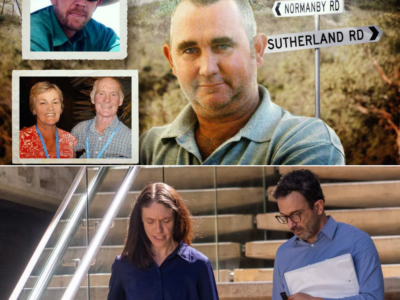
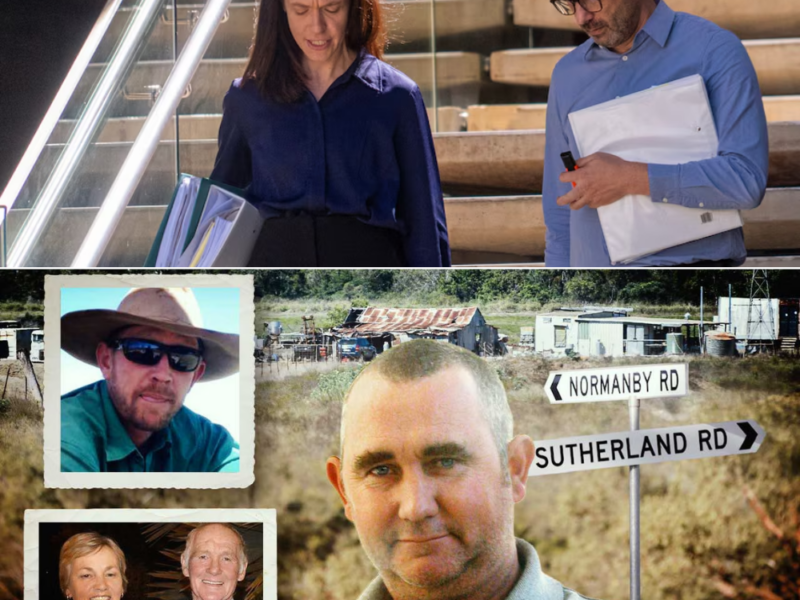
The evidence was heard as the Supreme Court trial of cattle farmer Darryl Valroy Young entered its third week in Townsville. Young, 63, has pleaded not guilty to three counts of murder and one count of attempted murder over the deaths of Graham Tighe, his mother Maree Schwarz and his stepfather Mervyn Schwarz. He is also accused of attempting to kill Graham’s brother, Ross Tighe.
The prosecution alleges the three victims were shot at the front gate of Young’s Shannonvale property on August 4, 2022.
Young’s defence disputes that account and maintains that he was not at the front gate when the shooting occurred.

Gunshot may have damaged Graham’s spine
The jury heard evidence from forensic pathologist Dr Rebecca Williams, who conducted post-mortem examinations on Graham Tighe, Maree Schwarz and Mervyn Schwarz between four and five days after their deaths.
According to Dr Williams, Graham suffered a gunshot wound to his torso that fractured part of his spine.
The Crown prosecutor asked whether the injury could have affected Graham’s ability to walk or move his legs.
Dr Williams said it was possible the injury had physically impaired him to the point where his legs were no longer able to move.
That evidence potentially provides an important insight into Graham’s condition during the moments before his death.
The court heard that all three victims sustained fatal gunshot wounds to the head. Graham and Maree also suffered gunshot wounds to their torsos.
The precise sequence of events remains a matter for the jury to determine.
However, Dr Williams’ evidence indicated that the torso wound to Graham likely occurred before the fatal injury to his head.
The possibility that Graham had been severely impaired before the final shot was one of the most confronting details heard during the latest stage of the trial.
Evidence about shooting distance
The pathologist was also questioned about the distance from which the victims may have been shot.
The autopsies found no signs of powder tattooing, stippling or muzzle impressions on the wounds.
Dr Williams told the court that Mervyn Schwarz’s head wound appeared to have been inflicted from a distance of more than two feet.
She also assessed the torso wounds suffered by Graham and Maree as appearing consistent with shots fired from a distance rather than at close range.
However, she was unable to establish the precise firing distance for the head wounds suffered by Graham and Maree.
The forensic evidence therefore provides the jury with information about the injuries and potential firing distances, but does not by itself establish who fired the weapon.
No fingerprints linking Young to the shooting
The medical evidence came as the defence continued to challenge the prosecution’s forensic case.
Detective Sergeant Anita Portage was questioned about whether investigators had discovered fingerprint or DNA evidence directly connecting Young to the alleged shootings.
The jury heard that there was no fingerprint or DNA evidence linking Young to the killings.
The absence of such evidence is expected to remain an important part of the defence case as lawyers challenge the prosecution’s interpretation of the broader evidence.
The defence has repeatedly questioned the investigation and the way physical evidence was collected and preserved at the Shannonvale property.
Gunshot residue kits were not analysed
The jury also heard evidence concerning seven gunshot residue kits collected during the investigation.
Samples were taken from the hands of Young, his son Derek Young, relative Sharon Young, the three deceased victims and inside a Nissan Navara.
Forensic scientist Lucy Maxwell explained why the samples were ultimately not analysed.
She told the court that the amount of gunshot residue on a person’s hands can diminish rapidly.
The majority of residue can be lost within approximately two hours, while the evidence heard in court indicated that it can effectively disappear within four hours.
Investigators also considered whether the person sampled was a licensed firearm holder and whether they had been in contact with specialist police officers.
Young, Derek and Sharon were all firearm licence holders and had contact with members of the Special Emergency Response Team. Their samples were also collected outside the relevant timeframe for analysis.
As a result, the samples were not tested.
The samples from the three victims were likewise not analysed because they were firearm licence holders.
The defence questioned whether gunshot residue could potentially have been transferred from a person’s hands to a vehicle or another surface. Maxwell described this as secondary transfer, but said such evidence was not typically analysed in the same way.
Defence challenges police investigation
The defence has also questioned how the Shannonvale property was secured following the shooting.
The jury heard that the wider property had been treated as a crime scene, while forensic examinations were conducted during the days following the deaths.
Defence lawyers raised concerns about the period during which the property was no longer being guarded before later searches took place.
Detective Sergeant Portage indicated she did not have concerns about the way the scene had been handled.
The competing evidence leaves the jury with two sharply different accounts of what happened at the rural property.
The prosecution alleges Young was responsible for the deaths of Mervyn and Maree Schwarz and Graham Tighe and for the attempted murder of Ross Tighe.
Ross has previously given evidence identifying Young as being present at the front gate during the shooting.
The defence, however, argues that Young was not there and has challenged the reliability and completeness of the evidence connecting him to the crime.
As the third week of the trial begins, the jury is therefore being asked to consider not only the devastating injuries suffered by the three victims, but also the wider forensic evidence — and its limitations.
Dr Williams’ testimony has provided a particularly grim picture of Graham Tighe’s final moments, suggesting that a bullet to his torso may have damaged his spine and left him unable to move his legs before he suffered the fatal head wound.
Young continues to deny the allegations against him. The charges remain before the Townsville Supreme Court, where the jury will ultimately decide whether the prosecution has proved the case beyond reasonable doubt.