Her Boyfriend Had It All Under Control — Until He Crossed The One Person He Should Never Challenge
PART 1
It happened between the soup and the main course.
Elena had been managing the evening well, or so she’d been telling herself for the past forty minutes. She’d ordered what Derek suggested — the risotto, not the pasta she actually wanted, because Derek had opinions about pasta and women who ordered carbohydrates — and she’d kept her shoulders back and her expression pleasant, and she’d been so perfectly compliant that the night had the fragile peace of a house built from wet paper.
Then the waiter came to refill the bread basket, and Elena said thank you and smiled at him, because that was what you did, that was what any human being with basic courtesy did, and the peace dissolved.
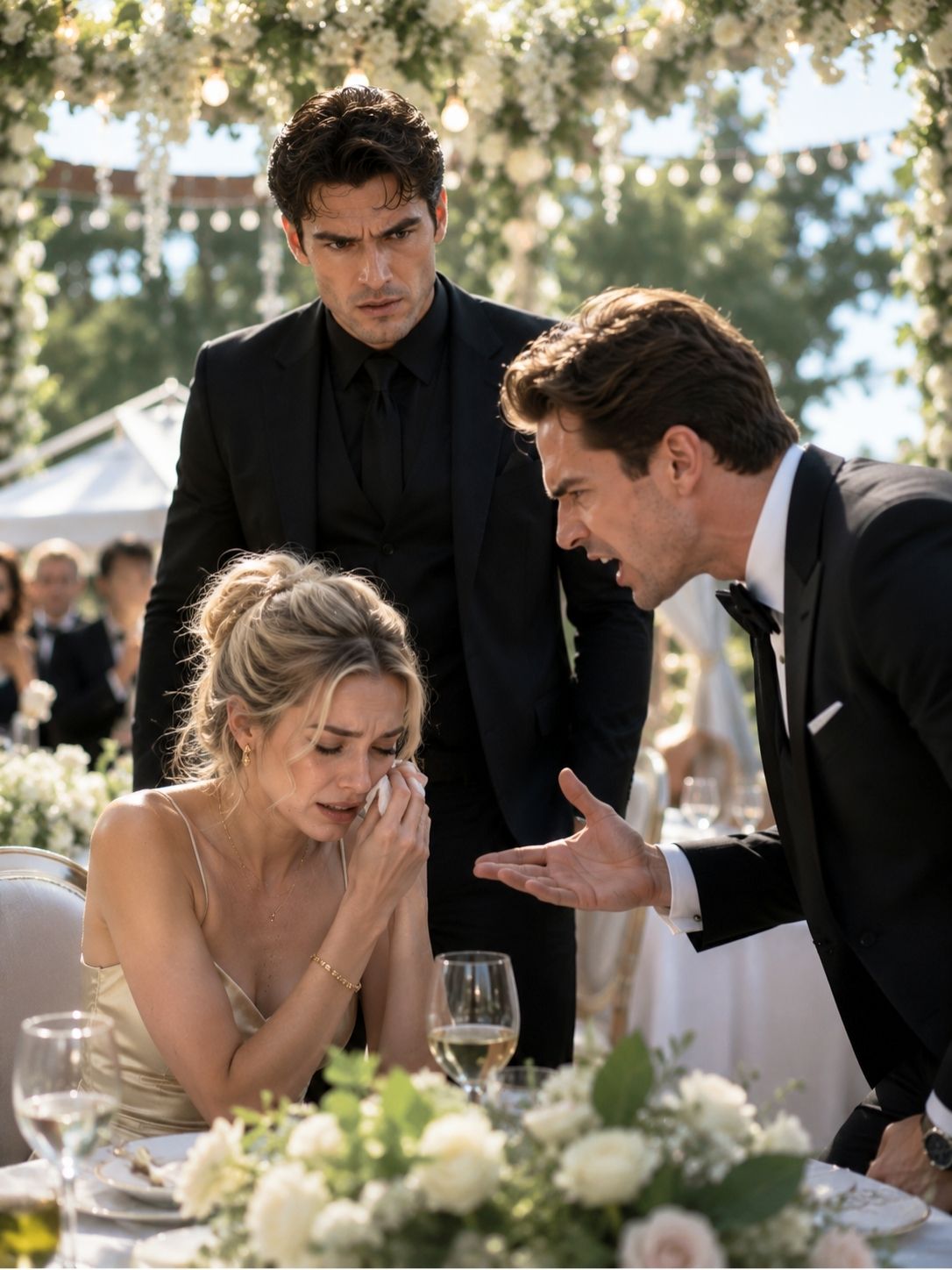
“You’re dead when we get home.”
Derek didn’t lower his voice. He wasn’t interested in privacy. Privacy was for men who were uncertain of their power, and Derek had never been uncertain of anything in his life.
Elena’s fork stopped halfway to her mouth. At the table beside them, an older couple glanced up from their plates.
“I said thank you,” she said. “That’s all.”
“You smiled at him.” His jaw was set at the particular angle she had memorized over two years, the one that meant the evening had already been decided and the only question was how much of herself she would lose to it. “You don’t smile at other men.”
He reached across the white tablecloth and gripped her wrist. Not hard enough for anyone to see the mark later, never that — Derek understood optics — but hard enough that the small bones ached. Hard enough that the bread basket and the candlelight and the soft music of Capretti’s, which was the most expensive restaurant in this part of the city, all became background noise behind the pressure of his thumb.
“Do you understand me?”
“I understand,” she said.
She always said she understood. She had been saying she understood for so long that the words had stopped meaning anything, had become instead a kind of key she kept ready, the one that opened the door from wherever they were to something slightly less bad.
He released her wrist and lifted his wine glass. “When we get home, you and I are going to have a long conversation about respect.”
She knew what that conversation looked like. It started with him standing in the doorway of whatever room she was trying to put between them. It continued until she had apologized for everything that had happened, the things she’d done and the things she hadn’t done and the things that existed only in his interpretation. It ended with her lying very still in the dark, listening to him breathe evenly beside her, wondering how a person could do what he’d done and sleep.
Two years. She’d spent two years trying to find the courage to leave, and every time she reached for it, something pulled it back — the life they’d built together, the apartment that was technically his, the friends she’d gradually lost contact with because Derek found reasons to dislike each of them, her mother’s voice saying he seems like a good provider, Elena, not every man is going to love you like this.
She looked down at her engagement ring. She hadn’t chosen it. He had selected it the same way he selected everything that touched her life — unilaterally, with the confidence of a man who considered her preferences an obstacle to efficiency.
“Eat your food,” Derek said. “You’re making a scene.”
She was making a scene. Of course she was.
The tears she refused to cry made everything blur slightly. She picked up her fork.
That was when she became aware of the man at the corner table.
She hadn’t noticed him before. He was sitting alone, which was unusual for a Friday night at Capretti’s — most people came to this restaurant in pairs or in groups, dressed in the particular way that said they were celebrating something or trying to. This man looked like he’d arrived from a different country entirely, one where the architecture was older and the expectations were heavier.
His suit was charcoal and precisely tailored. His dark hair was swept back, gray at the temples in a way that made him look like something carved rather than born. He was not young, but the age in his face was the kind that accumulates into a particular authority, the way certain buildings become more impressive with time rather than less. His eyes, dark in the restaurant’s low light, were fixed on Derek.
Not with curiosity. With the focused attention of a man who has already formed a conclusion and is now simply watching it confirm itself.
He glanced at her for a fraction of a second. Something crossed his face — she couldn’t name it — and then his gaze returned to Derek, steady and cold.
He had heard everything.
Heat climbed her face. It was bad enough to live inside the nightmare. Having someone witness it was a different category of awful, the kind that made her want to vanish through the restaurant floor.
She tried to make herself smaller. Tried to find the stillness that Derek preferred. If she stayed quiet and didn’t attract any more attention and managed the next forty minutes without incident, they would leave, and Derek would be satisfied with the evening, and by the time they got home he might have talked himself down from the threat.
She knew better. But hope was a difficult thing to kill, no matter how many times it deserved to die.
“I’m going to the restroom,” Derek announced, dropping his napkin onto the table. He leaned in close as he stood, close enough that she could smell the wine on his breath. “Don’t even think about going anywhere.”
She didn’t move. She sat perfectly still and exhaled for what felt like the first time in half an hour.
Then the man from the corner table picked up his wine glass and sat down in Derek’s empty chair.
He didn’t ask. Didn’t announce himself. Simply moved with the unhurried ease of someone who had decided something and saw no reason to negotiate about it.
Elena’s head came up. “What are you—”
“My name is Marco.” His voice was low and accented — Italian, she thought, real Italian rather than the affected kind. “And you need to listen very carefully, because your boyfriend will be back in approximately ninety seconds.”
Her heart hammered in her chest. “Please, you don’t understand. If he sees you here—”
PART 2
“He won’t hurt you tonight.” The certainty in it stopped her. “I can promise you that.”
“You don’t know him.”
“I know men like him.” His dark eyes held hers without effort. “I’ve known a hundred of them. They are all exactly the same. They find someone with a kind heart and they work on it, small piece by small piece, until there is nothing left but the accommodation of their anger.”
Something tightened in her throat. “I’m fine.”
The words came out before she could stop them — the automatic reflex of two years, the thing she said to her friend Petra when Petra asked careful questions, the thing she said to her colleague Diane when Diane had looked at her arm in the break room with her head tilted to one side.
“I’m fine,” she said again. “Really. He has a temper sometimes, but he doesn’t mean—”
“It will get worse.” He said it the way a doctor names a disease. Not unkindly, but without softening. “You already know this.”
She did. She had known it for longer than she wanted to admit, had known it with the part of herself that still functioned clearly, the part Derek hadn’t yet reached.
“Why do you care?” she asked, and the bitterness in it surprised her. “You don’t know me.”
Something moved through his expression, quick and contained. “Let’s say I have a particular dislike for men who threaten women in public.” He glanced past her shoulder. “He’s coming back.”
In the reflection of the restaurant’s dark windows she could see Derek crossing the room.
Panic seized her chest. “You have to go. Please, if he sees you sitting here—”
PART 3
“Let him see.” He looked at her with that same level calm. “The question is whether you want help, or whether you want to keep pretending that this is what love is supposed to feel like.”
The words landed somewhere deeper than she’d prepared for.
Before she could answer, Derek arrived.
“What the hell is this?”
Derek’s face had gone the specific color that Elena had learned to identify the way sailors learn to read weather. Not just anger — that was constant. This was anger encountering something unexpected, which was more dangerous.
“Who are you?”
Marco stood. He did it with the particular ease of a man who has never once had to convince anyone he was worth paying attention to. He was taller than Derek by several inches, and broader through the shoulders, and when he turned to face him, Elena saw Derek actually take a step backward.
She had never seen Derek take a step backward.
“My name is Marco Ferrante.” He said it without drama. Just the name, placed into the air between them.
Something happened to Derek’s face. The color changed, the set of his jaw changed, the particular architecture of his certainty collapsed slightly inward.
“This is none of your business,” Derek said, but the register had shifted. “Sarah — Elena. Tell him. Tell him this is a private matter.”
Marco turned to her, and in his expression she read something she hadn’t expected: a question. Actual space for her to answer however she chose.
Every eye in the restaurant had found them. She could feel the weight of it — the held breath of other diners, people pretending to look at their menus, the waiter frozen near the kitchen door.
Derek’s eyes were on her. The fear in them was new and she didn’t know what to do with it.
“Tell him,” Derek said. His voice had a quality she’d never heard before, something stripped and exposed. “Tell him you want to leave with me. Tell him this is just a misunderstanding.”
She looked at Derek. At the face she had spent two years trying to read, trying to stay ahead of, trying to manage and soften and accommodate. At the ring on her finger that she hadn’t chosen.
She looked at Marco. At a stranger who had sat down beside her without asking because he had decided it needed doing.
“No,” she said.
The word was barely sound. But Marco heard it.
“No,” she said again, and this time the whole restaurant heard it too.
Derek’s expression twisted. “You don’t mean that. You’re confused. This man is confusing you. Elena—”
“She was clear.” Marco’s voice cut through the noise the way a blade cuts through water, smooth and without effort. “She’s not leaving with you.”
Derek reached for her arm. He didn’t reach it.
Marco moved with a speed that seemed impossible for a man his size, and suddenly Derek’s wrist was locked in his grip at an angle that made Derek gasp. The restaurant went absolutely still.
“If you touch her,” Marco said, very quietly, “you will regret it at length.”
He released Derek with a slight push. Derek stumbled backward.
Two men in dark suits materialized from somewhere in the room. Elena hadn’t seen them arrive. They simply existed suddenly, flanking Derek on either side with the blank professional patience of men who had done this before and would do it again.
“Escort him out,” Marco said. He glanced at Elena with a question in his eyes.
“Brennan,” she said weakly.
“Escort Mr. Brennan out. And please ensure he understands he’s not welcome back at any establishment with a connection to my family, which in this city is a fairly long list.”
The men nodded. They didn’t grab Derek. They didn’t need to. Their mere presence was sufficient to get him moving.
He looked back at her over his shoulder as they guided him toward the exit. The anger had burned down to something rawer.
“This isn’t over,” he called back. “You hear me? This isn’t—”
One of the suited men said something quiet. Derek went silent.
And then he was gone.
Elena sat frozen.
Her whole body was trembling, a fine, continuous tremor that she couldn’t control, as if everything she’d been holding tightly was now shaking itself loose. The restaurant around her had slowly returned to the pretense of normal — silverware finding plates again, voices resuming, the waiter reappearing at a nearby table with a kind of determined professionalism.
Marco settled back into his own chair. Then he paused and looked at her.
“You should eat something,” he said. “You’ve gone quite pale.”
“I don’t—” Her hands were shaking visibly now. She pressed them flat against the table. “I don’t understand what just happened.”
“You told the truth. In my experience, that’s always the most disorienting part.”
“Who are you?” She looked at him properly now, the way she hadn’t allowed herself to before, taking in the details of the face and the suit and the particular quality of stillness that surrounded him. “That name — Marco Ferrante. He recognized it. The look on his face—”
“Derek is a small, frightened man who understands just enough about how power operates in this city to be afraid of the right people.” Marco’s tone was neutral, neither proud nor apologetic. “I am one of those people.”
She asked the question she already knew the answer to. “Are you—”
“A criminal?” The corner of his mouth moved. “By certain definitions, yes. By others, I’m a businessman with a complicated family history. It depends on who’s asking and why.”
She should have been terrified. Should have grabbed her bag and thanked him and walked out and never looked back. She stayed where she was.
“Why did you help me?”
He was quiet for a moment. When he spoke, his voice had a different quality — still controlled, but something had shifted in it, something that cost him slightly more than his usual composure.
“My sister,” he said. “She was engaged to a man like Derek. By the time I understood how serious it had become, it had become very serious indeed.” He looked at the table between them. “She is well now. She lives in a village outside Florence with a man who treats her the way she deserves to be treated, and she grows tomatoes and complains about the heat. But I was almost too late to help her, and I have not forgiven myself for that.”
Elena felt the tears come before she decided to let them. “I don’t know what to do,” she said. “I don’t know where to go. Everything is at his apartment. My car is there. My— everything.”
“One thing at a time.” He signaled to the waiter with a small gesture that produced immediate results. “Hot tea, please, and whatever your kitchen recommends for dessert.”
Then he pulled out his phone. The conversation he had on it was brief and in Italian and ended with what sounded like firm instructions.
“Your belongings will be removed from that apartment within the hour,” he told her. “They’ll be kept somewhere secure until you tell me where to have them taken. Your car will also be retrieved.”
“That’s — you can’t—”
“I didn’t ask permission,” he said simply. “I made a decision. You’re welcome to refuse, but it seems to me you’ve been given enough to refuse in recent years. I’d rather offer something else.”
The waiter arrived with tea and a piece of tiramisu that looked almost too beautiful to be real. Elena took a small bite. The sugar moved through her like warmth through cold stone.
“I don’t know how to thank you.”
“Don’t thank me yet. The difficulty is only beginning.” He met her eyes. “Men like Derek believe they own the people they’re with. When you leave — and you are leaving — he will try to bring you back. When that fails, he will try to make you regret leaving. You need to be prepared for that.”
The words were ice in her chest, but not the bad kind. The clarifying kind.
“What should I do?”
He reached into his jacket and produced a business card — heavy, cream-colored, embossed, with a single phone number and no other information.
“You call this number if he contacts you, if he appears near your home or your work, if he sends anything at all. Day or night.” His dark eyes were steady on hers. “Someone will take care of it.”
She stared at the card in his hands. “Take care of it how?”
“In whatever way ensures your safety.” He held her gaze. “I will not lie to you about what that sometimes means, but I will tell you that you have nothing to be afraid of from my side.”
She took the card.
“There’s something else,” he said, and something in his tone made her look up. “When I saw you tonight. When I saw you making yourself smaller and smaller in that chair.” He paused, choosing the words with a care that seemed unusual for him. “You felt familiar to me. Not in the way of having met before. In the way of— recognizing something worth knowing.”
It should have sounded strange. It was a strange thing to say, sitting across from a woman he’d met twenty minutes ago in the middle of the wreckage of her evening. But there was no performance in it, no reaching for effect. Just a simple statement, as if he’d said it is raining and was mildly surprised to find himself saying it.
She didn’t know what to do with it.
So she ate her tiramisu, and he waited quietly, and neither of them tried to fill the silence with anything it didn’t need.
Her friend Petra arrived forty minutes later, arriving through the restaurant doors like weather, blonde hair and blazing eyes and the particular forward momentum of someone who had driven too fast because they were furious.
She saw Elena’s face and pulled her straight into a hug. “I’m going to kill him,” she said into Elena’s hair. “I mean it. I’m going to—”
“I believe that’s been addressed,” Marco said, mildly.
Petra turned and looked at him. Her expression moved through several things in quick succession. “Wait. You’re Marco Ferrante.”
“You know him?” Elena asked.
“Of him.” Petra’s voice had shifted into something between awe and alarm. “My brother works in finance. He says three of the largest property portfolios in this city trace back to Ferrante family holdings.” She looked at Marco. “Is that true?”
“It’s a reasonable estimate,” Marco said. He stood. “Take care of her. And, Elena—” He waited until she was looking at him. “What you did tonight required courage. Please don’t forget that.”
He walked back into the restaurant and left them in the lobby.
Petra stared after him. Then she turned to Elena. “Okay,” she said. “We need an enormous amount of wine and you need to tell me absolutely everything.”
Elena let herself be led to the car. As they pulled away from Capretti’s, she caught one last glimpse of Marco through the window, returned to his corner table, sitting alone with his meal barely touched.
She thought about what kind of man ate alone at expensive restaurants on Friday nights. What kind of man stepped into a stranger’s crisis without a moment’s hesitation. What kind of man he actually was.
She held his business card carefully the whole way home.
The two weeks that followed were the strangest of Elena’s life.
She moved into Petra’s spare room, which smelled of turpentine and old books, and surrounded herself with her own belongings, which appeared exactly as Marco had promised — packed carefully, nothing missing, delivered in boxes that bore no label and arrived in a van whose driver handed her the keys to her own car along with an envelope containing no note.
Derek tried.
Seventeen texts, nine calls, four emails. Each one cycling through the same terrain: anger, then apology, then something that tried to sound like grief, then threats dressed in the language of concern. She blocked him on everything. Changed her passwords. Called her landlord and arranged to have her portion of the lease dissolved — Derek, it turned out, was the primary leaseholder, which had always been the plan, she understood now.
She used the card three times.
The first time was on the fourth day, when Derek appeared at the entrance of the clinic where she worked as an administrator. He made it through the front door and no further. Security appeared from somewhere with the unhurried efficiency of people who had been expecting him, and he was escorted out, and when she asked the building’s manager how he had known, the manager looked puzzled and said he’d simply received a call.
The second time was on day nine, when Derek’s mother left a voicemail explaining that her son was devastated and confused and that three years together meant something and surely Elena owed him an explanation. The call was returned by someone on Elena’s behalf. She never learned what was said, but Derek’s mother did not contact her again.
The third time, on the fourteenth day, she called the number not because she had a problem but because she’d been staring at her ceiling for an hour and she wanted to hear his voice.
She told herself she had a question about logistics.
“Miss Vasquez,” said the person who answered. “May I ask who’s calling?”
“Elena. He’ll know.”
Two minutes passed. Then: “Are you all right?”
She had prepared an answer about logistics. What she said instead was: “Yes. Actually. I think I might be better than all right.”
A brief silence. “That’s good to hear.”
“I wanted to thank you. For everything.” She sat up straighter. “And I wanted to know if the dinner invitation was still open.”
This pause was longer.
“It is,” he said finally. “But I want to be honest with you, Elena. My life is complicated. There are parts of it I can’t discuss, things I can’t always explain. If you want to know me, you need to understand that coming in.”
“I think I understand more than you might expect.”
“I don’t think you do,” he said, not unkindly. “But I would like very much to try to explain it to you. If you’re willing to let me.”
“Tonight?”
“If you’re free. I’ll send a car at seven.”
Petra, when Elena told her, was torn between horror and fascination. She stood at the window with her phone raised as the sleek black car pulled up at seven sharp. “I’m tracking your location,” she called. “If you’re not back by midnight I’m calling—”
“The police won’t be of much help in this particular situation,” the driver said, pleasantly, through the open window.
Petra’s expression cycled through several things.
“But don’t worry,” he added. “Mr. Ferrante has asked me to ensure your friend’s complete safety and comfort this evening.”
The drive took them out of the city entirely, up into the hills where the streetlights gave way to gates and the gates gave way to long drives lined with old trees. The house at the end of one such drive was stone and tall windows and gardens, not modern or ostentatious but the kind of beautiful that accumulates over generations rather than being purchased all at once.
Marco was at the door.
Dark trousers, white shirt, sleeves rolled to his elbows. No jacket, no performance. He looked more imposing here than he had in the restaurant, which she hadn’t thought possible. Or maybe it was simply that seeing him in his own space made the reality of what she was doing land more completely.
“You came,” he said.
“Was that in question?”
“I hoped. And doubted. In roughly equal measure.”
He led her through the house — beautiful in the way of things that have been carefully lived in — to a terrace that opened onto a view of the valley, the city’s lights spread below them like a circuit board, glittering and indifferent and magnificent.
A table had been set for two. Candles already lit. Wine already poured.
“No restaurant?” she asked.
“I thought perhaps you’d had enough of that particular setting for a while.”
She sat down. The first course arrived, brought by someone who appeared and disappeared without introduction.
“I owe you honesty,” Marco said, settling across from her. “About who I am, what my family does.”
“You’re in the mafia.” She said it directly, watching his face.
“That word.” He almost smiled. “Americans love that word. But essentially, yes. My family has been involved in certain enterprises for several generations. My father operated in the old way — territory, intimidation, power expressed through violence. I’ve spent most of my adult life changing that.” He reached for his wine. “We’re legitimate now, in the ways that matter legally. Real estate, logistics, private investment. But the old connections exist, and the old obligations don’t simply dissolve because I prefer cleaner accounting.”
“The men at the restaurant. The security at my office. Those weren’t legal channels.”
“No. Those were personal.” His eyes held hers. “I chose to use resources I have for your benefit. I’d make the same choice again.”
“Why?”
“Because you deserved it.” He said it simply. “And because—” He stopped. Started again. “Because when I watched you that night trying to become invisible in your own chair, I understood something. That you were someone worth stepping forward for.”
She looked at her hands. “That probably sounds—”
“Overwhelming, yes. I’m aware.” His voice was dry and not unkind. “I’m not a young man who doesn’t know his own mind. I’m not going to tell you I have no expectations or that this is uncomplicated. It’s very complicated. What I can tell you is that I won’t lie to you, and I won’t make decisions that involve you without you, and I won’t ask you to disappear.”
She thought about Derek’s hand on her wrist. About the ring she hadn’t chosen. About two years of learning to take up less space.
“What will I need to get used to?” she asked. “If I stay. If this becomes something.”
“Men in suits appearing at odd hours. Conversations you won’t be invited into. A family that is large and loud and has opinions about everything.” He considered. “My mother in particular. She is small and she is terrifying and she will tell you within the first ten minutes whether she approves of you.”
“Does her approval matter to you?”
“Enormously. Which is why I want you to meet her only after I’ve had time to properly prepare both of you.”
Elena laughed. A real laugh, full enough that it surprised her.
It seemed to surprise him too. Something opened in his expression.
They talked through dinner and long after. He told her about his family — three siblings, a mother who had weathered things that would have destroyed someone with a smaller spine, a father who had died five years ago leaving behind a legacy Marco had been quietly dismantling ever since. He asked about her and listened to the answers with the full attention of someone who is actually interested, not performing interest.
She told him about the clinic, about the administrative work she’d fallen into when the life she’d planned hadn’t materialized. About her parents, her mother’s well-meaning blindness. About how Marcus — Derek — had seemed like kindness at first, how the erosion had been so gradual that she’d adjusted to each new loss before she even noticed it was gone.
“I kept thinking,” she said, “that if I tried hard enough I could find the version of him that I’d first met. That he was in there somewhere and I just wasn’t doing the right things to reach him.”
“The version you met at first was a performance,” Marco said quietly. “That’s what they do. They show you what you need to see until the investment is too high to walk away from.”
“When did you know? With your sister?”
“I didn’t know until I saw it plainly. And then I was angry with myself for a very long time for having not known sooner.” He looked at the valley below them. “I have done things in my life that I’m not proud of. I have operated in darkness and I have made choices that had consequences for people who didn’t deserve them. But I will tell you this: what I did to the man who hurt my sister, I don’t regret for a single moment.”
She believed him. She wasn’t sure she should, but she did.
It was nearly midnight when she finally reached for her phone and found seventeen messages from Petra. Marco walked her to the door where the car was waiting. The night had gone cool and the city lay below them, brilliant and distant.
“Will I see you again?” she asked.
“I intend to ask you to dinner again,” he said. “Somewhere you can actually enjoy your food. And I should tell you something.”
“What?”
“The night in the restaurant. I told myself I was acting out of principle. Doing the right thing because it needed doing and someone needed to do it.” He looked at her steadily. “That was true. But it wasn’t the whole truth.”
She waited.
“The whole truth is that from the moment I saw you, I knew you were going to matter to me. I don’t say that to put pressure on you. I say it because I told you I won’t lie, and pretending otherwise would be a lie.”
She thought about everything she’d been taught to distrust about her own instincts. About two years of having her perceptions corrected and her feelings reframed until she’d stopped trusting either.
“Okay,” she said.
“Okay?”
“Okay. Ask me to dinner again.” She met his eyes. “And I’ll say yes.”
He smiled. The full version, the one that reached everything and changed the entire geography of his face. “Good.”
In the car on the way back, she sat in the leather seat in the dark and held the business card in her hand — she’d never stopped carrying it — and felt something she hadn’t felt in so long she’d almost forgotten it had a name.
Safe.
He called the next morning.
Over the six months that followed, Marco Ferrante courted her with the same thoroughness he seemed to bring to everything — not grand gestures or expensive demonstrations of wealth, but consistent, deliberate attention. Texts throughout the day that asked about her work, her lunch, the novel she was reading. Flowers that arrived without announcing themselves. Plans made with her input rather than presented as decisions.
She met his mother, Signora Ferrante, at a dinner at the estate that Marco treated with the seriousness of a diplomatic summit. The old woman was small and silver-haired and had eyes that registered everything within thirty feet of her. She looked Elena over in complete silence for approximately ten seconds.
“You’ll do,” she said finally.
Marco’s visible relief told Elena everything about the weight he’d placed on that meeting.
She met his siblings: Nico, who was quiet and methodical and had his brother’s eyes; his younger sister Valentina, who hugged Elena immediately and said “thank God, an actual person”; and Rosaria, the oldest, the sister from Florence. Rosaria held Elena’s hands for a long moment before she spoke.
“He told me about you,” she said. “About what you survived.” She had a faint scar below her jaw that she wore with the matter-of-fact dignity of a woman who had decided scars were a record rather than an embarrassment. “Welcome to the family.”
Elena understood, meeting her, what Marco had almost lost. What it had cost him not to see sooner. She understood also why the man at the next table in Capretti’s had not been able to look away.
She learned the Ferrante world gradually, the way you learn a language — immersion before grammar, feeling before comprehension. She learned which men in suits were part of the regular orbit and which ones appearing unannounced meant Marco had a problem requiring full attention. She learned that he would answer her questions honestly or tell her directly that something was not something he could discuss, and that there was a meaningful difference between those two responses. She learned the particular quality of his silences: the one that meant he was thinking, the one that meant he was managing something difficult, the one that meant he was simply content.
She also learned about the foundation.
He told her one evening over dinner at the estate, four months into whatever they were, approaching it with the same care he brought to everything he considered important.
“I’m opening a resource center,” he said. “For women leaving difficult situations. Housing, legal support, counseling — real infrastructure, not just a hotline. I have the funding and the connections, but I need someone at the center of it who actually understands what that experience is from the inside.” He looked at her steadily. “I want you to run it.”
“Marco—”
“You have knowledge I can’t manufacture by hiring the most qualified administrator in the city. You know what those women are afraid of. You know what they need and what questions not to ask in the first hour and how to make someone who has learned to distrust her own judgment start to trust it again.” He held her gaze. “I’m putting significant resources behind this. But the resources are useless without the right person leading it. I believe that person is you.”
She sat with it.
Then she said yes.
Six months after a Friday night at Capretti’s when she had been trying to become invisible, Elena Vasquez became the founding director of the Ferrante Women’s Resource Center, operating out of a converted brownstone in the city’s old quarter, funded quietly by a man with a complicated past who had decided this was a useful way to spend some of his considerable resources.
Three weeks after the center opened, Marco dropped to one knee in the study of his estate and produced a ring from a small case — antique, an emerald ringed in old diamonds, the kind of object that carries generations in it.
“My grandmother,” he said. “She told me to keep it for someone who had actually earned it.” He looked up at her. “Marry me, Elena. Not because I helped you. You helped yourself. But because I love you, and because you have changed the way I understand what it is that I’m supposed to be doing with my life.”
Her hands were shaking. Not from fear. “Yes,” she said. “Yes. Yes.”
The ring fit exactly.
Three months after their wedding, Elena woke at 2 AM to the sound of a car door.
She had been a light sleeper since Derek. That was one of the things he had given her that she hadn’t been able to return — a permanent attentiveness to sound at the edges of sleep, a body that had learned to stay half-ready even when resting. The therapist she’d been seeing through the foundation’s own network told her it would ease with time. She believed her.
She was standing at the kitchen window in the dark, a glass of water in her hand, watching the city lights below the hills, when she heard footsteps on the gravel.
Their property had security — cameras, a gate, two men on regular patrol. Whoever had made it to the main house had either been permitted or had been expected.
The bell rang.
Elena checked the monitor on the kitchen wall.
Derek Brennan stood on the doorstep of her home.
She hadn’t seen him in six months. He looked like those six months had taken something from him — thinner, hollow-eyed, his suit wrinkled in the way of a man who had stopped performing normalcy. His hair was uncombed. His expression was something she’d never seen on him before and couldn’t immediately name.
He was holding a gun.
She did not open the door. She pressed the intercom.
“Derek. Leave now.”
His head snapped toward the camera. “Elena. Thank God.” His voice had a quality she’d never heard from him — raw, stripped, the performance gone entirely. “I just need to talk to you. Five minutes.”
“I have nothing to say to you. Leave, or I will call the police.”
“Please.” He pressed one hand against the door and she could see it shaking. “Please. I just need to explain. Everything fell apart after you left. I lost my position. My family won’t speak to me. Everyone acts as though I’m some kind of monster when I was the one who—”
“Derek.” She kept her voice flat. “You are standing on my doorstep with a weapon.”
He looked down at the gun in his hand as if genuinely surprised to find it there. “I’m not — I wasn’t going to—” He looked back at the camera. “I just wanted you to take me seriously. I just wanted you to really hear me this time.”
“I heard you every time.” She pressed her back against the wall beside the monitor. Her hands were steady. She was noting this about herself even now. “Go away.”
“You replaced me. Three months and you married him. Like I was nothing. Like everything we had—”
“Everything we had,” she said, “was you frightening me.”
He slammed his palm against the door and she flinched before she could stop herself. “I loved you. I gave you three years and you—”
“I know.” Marco’s voice came from the staircase behind her.
She turned.
He was barefoot, wearing only dark trousers, moving with the particular focused quiet of a man who has woken up and assessed a situation and decided what it requires. He had his phone in one hand. In the other was a gun she had known he owned and had never actually seen him hold.
He looked at her face first. A rapid check, thorough and quiet, that told him what he needed to know. Then his eyes went to the monitor.
He put a finger to his lips. Gently took the intercom from her.
“Derek,” he said. Calmly. The way you say a word you have no emotional investment in. “You have ten seconds to put the weapon down and step back from my door.”
“You.” Derek’s voice changed entirely. “This is your fault. All of it. You took her from me.”
“She was never something to be taken.” Marco’s gaze was on the monitor. “Eight seconds.”
“I’ll kill you. I’ll kill both of you. You can’t just—”
“Six seconds. My security team has been watching you since the gate. There are currently three weapons pointed at you.” A pause, perfectly timed. “I suggest you think very carefully about your next decision.”
Elena watched the monitor. She watched Derek’s face move through the stages of something — rage, then calculation, then the particular deflation that follows when a person understands that all the leverage they believed they had is not leverage at all.
His arm dropped. The gun fell from his hand and hit the stone step.
Derek Brennan dropped to his knees.
He was crying. Great, shuddering sobs that shook his whole body. “I’m sorry. I’m sorry. I just wanted her to—I wasn’t going to—”
Elena watched him, this man she had spent two years trying to appease and three years trying to leave and six months trying to stop being afraid of, and she felt something that was neither hate nor pity but something closer to understanding. He had done what he was. She had survived it. Both things were true and neither one cancelled the other out.
Marco spoke quietly into his phone. Four men appeared from the dark outside as he had promised, surrounding Derek with the unhurried patience of men who had done this before.
“Take him to the police,” Marco said into the phone. “Armed trespassing, criminal harassment, prior documented threats. Make sure they have the full record.” He ended the call. “He won’t make bail easily with the file we have.”
He set his gun down on the counter and turned to her. The focused efficiency was gone, replaced by something warmer and more careful.
“Hey,” he said.
“I’m steady,” she said. And then, because it surprised her: “I actually am.”
“I know.” He came to her and put his arms around her and she let herself be held the way she had learned over the past months she was allowed to be held — not because she needed someone stronger to lean on, but because this was what people who chose each other did, they put their weight against each other and both of them stood better for it.
“He had a gun,” she said into his shoulder.
“He did.”
“He came here with a gun because he couldn’t tolerate that I had a life without him.”
“Yes.”
She pulled back to look at Marco’s face. “You said he’d understand it was over.”
“He’s understood now,” Marco said. “The understanding is simply coming with a custody arrangement with the criminal justice system.”
She almost laughed. Almost.
Through the window, she watched the security team load Derek into a vehicle. His sobs had quieted to something smaller and more internal. She watched him go without the feeling she’d expected — not triumph, not relief, not the particular weight of something finally finished. Just a clear, clean awareness that she was on the right side of the door and he was leaving it.
“Come back to bed,” Marco said.
She called Rachel first.
Rachel Chen was twenty-six years old and had been living in one of the foundation’s emergency apartments for three weeks after leaving a man who tracked her phone and had stopped pretending to be subtle about it. Elena had placed her herself and called to check in three times since.
Rachel picked up on the second ring. “Miss Vasquez? Is everything okay?”
“I’m fine. I wanted to make sure you knew you’re safe. Whatever happens with your situation — whoever comes looking — you’re protected. I promise you that.”
“How can you promise that?”
Elena looked at her husband, who was watching her with an expression of patient, private warmth.
“Because I have resources,” she said, “and I’m not afraid to use them.”
She couldn’t sleep, and didn’t try.
She made tea and sat at the kitchen table and after a while Marco came down and sat across from her and they didn’t talk about Derek or guns or the shape of the past six months. They talked about the foundation — the three intake requests that had come in that week, the counselor she was thinking of hiring, the grant she was applying for to expand the emergency housing program.
He had a natural facility for the logistical problems. She had the rest.
“Rachel,” she said at some point, her hands around her cup. “She said something yesterday. That she found us through the internet. That there’s apparently a whole thread about—” she paused. “About the night at Capretti’s.”
Marco’s expression was carefully neutral. “Is that so.”
“They call me ‘the mafia boss’s bride.’” She watched his face. “Apparently someone saw the whole thing and posted about it and it spread.”
“Does that bother you?”
She thought about it. “No,” she said. “It brought Rachel to us. It might bring others.” She put her cup down. “Is it true? What they call you?”
“The mafia part is accurate.” He looked at her. “The boss part is a simplification. I prefer managing director.”
She did laugh this time.
He reached across the table and took her hand. Held it the way he always held it — like something he wanted to be careful with, not because it was fragile, but because it mattered.
“Are you really all right?” he asked.
“I’m really all right.” She turned her hand in his so their fingers were interlaced. “I keep expecting the fear to come back. It’s been the background of everything for so long. But tonight I watched him on that camera and I felt—” she searched for it. “Clear. Like I could see the whole thing exactly as it was.”
“You were never afraid of him,” Marco said. “You were afraid of what it would cost you to stop accommodating him. Those aren’t the same thing.”
She thought about that for a long time.
“What did you do?” she said finally. “In those six months. Between the night at the restaurant and tonight. What actually happened to Derek.”
“He encountered consequences,” Marco said, “proportionate to his behavior. Some of them legal. Some of them were the natural result of having a reputation that preceded him. None of them were permanent, because I didn’t want to make him a martyr. I wanted to make him understand.”
“Did he?”
“He understood enough to stay away for six months. Tonight he ran out of whatever it is that keeps men like him from doing the final stupid thing.” He paused. “But that’s finished now.”
She nodded. “The foundation,” she said. “We helped nineteen women this month. Three emergency placements, four legal referrals, twelve counseling connections.” She looked at her hands. “I keep thinking about how many more there are.”
“There are always more.” His voice was quiet. “That’s the nature of it. But nineteen is not nothing. Nineteen is everything to nineteen people.”
She went back to bed eventually, and this time she slept.
In the morning, there was a note on his pillow.
Brennan in custody. Held pending arraignment — Nico says the file is extensive. He is not having a good morning.
Valentina called while you were sleeping. Her gallery opens Thursday, attendance mandatory per standing Ferrante family decree.
Your 9 AM intake is moved to 10. The counselor you’re interviewing is early and waiting in the lobby.
Also: I love you. Come find me when you’re ready. I’m in the garden.
Elena read it twice. Then she got up, made coffee, and pulled on the clothes she’d left on the chair.
She paused at the window. The city below the hills was doing what it did every morning — making itself new, dismissing the night with the practical efficiency of a place that had seen too many dramatic evenings to find any of them remarkable. The garden below was visible from here, green and ordered and too large for any one person to maintain alone, which was why it had a staff and also why Marco liked to walk in it early, before the house fully woke.
She could see him from here. Standing at the far edge near the rose beds, coffee in hand, facing the valley. Just standing.
She thought about the woman who had been sitting at a restaurant table six months ago, trying to become invisible, shaking too much to eat her pasta. She thought about everything that woman had believed about herself — that she wasn’t capable of leaving, that she wasn’t brave enough, that the life she was living was the life she had access to.
She thought about a stranger who had looked over from the next table and decided that was not something he was going to watch without acting.
She finished her coffee and went to find him.
She had a foundation to run, a husband to love, nineteen women whose lives had changed and more who were still finding their way to the door. She had work she believed in, people who depended on her, and a morning that was hers to step into.
The gate to the garden opened easily. Marco heard her on the path and turned, and when he saw her face, he smiled — the real version, the one that reached everything.
She reached his side and they stood together for a moment, looking at the valley, at the city in the distance doing its ordinary miraculous thing, at the light moving across it.
“Good morning,” he said.
“Good morning,” she said.
And she meant it, all the way through, without the modification of fear.
THE END