My Future Son-in-Law Thought I Couldn’t Understand French—One Conversation Destroyed His Entire Family
“They think you’re a lonely, foolish widow,” my future son-in-law told his father in French. “Once Emily signs the papers, her mother loses everything.” I sat three feet away, smiling as though their words meant nothing. What Julien did not know was that I had spent thirty-two years hunting international fraud—and the documents hidden in my handbag could send his entire family to prison.
The moment my future son-in-law’s mother called me “a useful little widow” in French, I realized the engagement dinner was not a celebration—it was an ambush. I kept smiling, raised my wineglass, and let them believe I understood nothing.
My daughter, Emily, sat beside her fiancé, Julien Moreau, glowing with happiness. Across from us, Julien’s parents, Philippe and Celeste, wore the polished expressions of people accustomed to being admired. They had flown from Paris to my Boston home and spent dinner praising my cooking while examining the rooms like appraisers.
“It’s charming,” Celeste said in English. Then she switched to French.
“After the wedding, Julien can convince Emily to sell this place. The old woman won’t need so much space.”
Philippe smirked. “The property is worth three million. She probably has investments too. Widows hide money because they fear dying alone.”
Julien glanced at me. “Emily thinks her mother is simple. She trusts me completely.”
My fingers tightened around the glass.
Emily had told me Julien worked in international finance. She had not told me he had lost his job, accumulated enormous debt, and pressured her to combine their accounts before the wedding. I knew because I had reviewed the documents she reluctantly showed me that morning.
For thirty-two years, I had worked as an attorney specializing in cross-border fraud and asset recovery. I spoke fluent French, Italian, and enough German to frighten dishonest bankers. Retirement had given me gray hair, comfortable sweaters, and the useful ability to look harmless.
Celeste continued. “Make sure Emily signs the marriage contract before another lawyer sees it.”
Philippe lowered his voice. “And transfer the lake house before the wedding. Once it belongs to Emily, Julien controls it.”
Julien squeezed my daughter’s hand.
“Your mother looks tired,” he said in English. “We can discuss the family trust later.”
I smiled. “No, please. I’m fascinated.”
For half a second, his expression changed.
That night, Emily found me washing plates.
“Mom, they like you.”
“I was listening,” I said. “Tomorrow, ask Julien for proof of employment, a credit report, and every document he expects you to sign.”
Her face hardened. “You’re judging him.”
Emily looked away, and I saw the first crack beneath her certainty. For weeks, she had defended every unanswered question: the delayed paycheck, the missing office address, the sudden urgency about money. I hated frightening her, but I hated more the thought of watching strangers turn her love into a weapon. So I said nothing else that night. Not yet.
“No. I’m giving him a chance to prove me wrong.”
Upstairs, my phone buzzed. An old colleague from the Financial Crimes Division had sent six words:
We found Julien. Call me now.
PART 2
By sunrise, I knew exactly whom my daughter planned to marry.
Julien had been dismissed from a Geneva bank after investigators uncovered unauthorized transfers tied to shell companies in Luxembourg. Charges had stalled because key evidence vanished before regulators arrived.
Philippe Moreau was a consultant to two of those companies.
Celeste owned an apartment purchased through a third.
They were not aristocrats. They were elegant scavengers.
I did not tell Emily everything immediately. Love, when cornered, often defends the knife cutting it. Instead, I asked her to delay signing anything for forty-eight hours.
She agreed.
Julien did not.
That afternoon, he arrived carrying flowers and a leather folder.
“I thought we could simplify matters,” he said. “Emily says you intend to gift her the lake house.”
“I said I was considering it.”
“The wedding requires financial certainty.”
“Venues require deposits, not real estate.”
He leaned closer. “I know you want Emily protected. So do I.”
In French, he muttered, “Stubborn old cow.”
I met his eyes. “Pardon?”
He froze.
Then I smiled. “Would you like tea?”
That evening, the Moreaus hosted dinner at their hotel. They invited a notary carrying a “premarital family arrangement.” The document transferred my lake house into a holding company controlled by Emily and Julien. Another clause gave Julien authority if Emily became “temporarily incapacitated.”
Emily read it twice. “Why would you need that?”
“It’s standard,” Julien said.
“It is not standard,” I replied.
Philippe’s voice sharpened. “You are not licensed in France.”
“I don’t need a French license to recognize fraud in Massachusetts.”
Celeste smiled coldly. “Retirement has made you suspicious.”
“Experience made me careful.”
Julien shoved back his chair. “Emily, your mother is controlling you.”
“No. I’m stopping you from controlling her.”
Philippe spoke rapidly in French. “Calm down. She understands little. Sign tonight, move the funds tomorrow, and leave before she finds anything.”
I placed my napkin beside my plate.
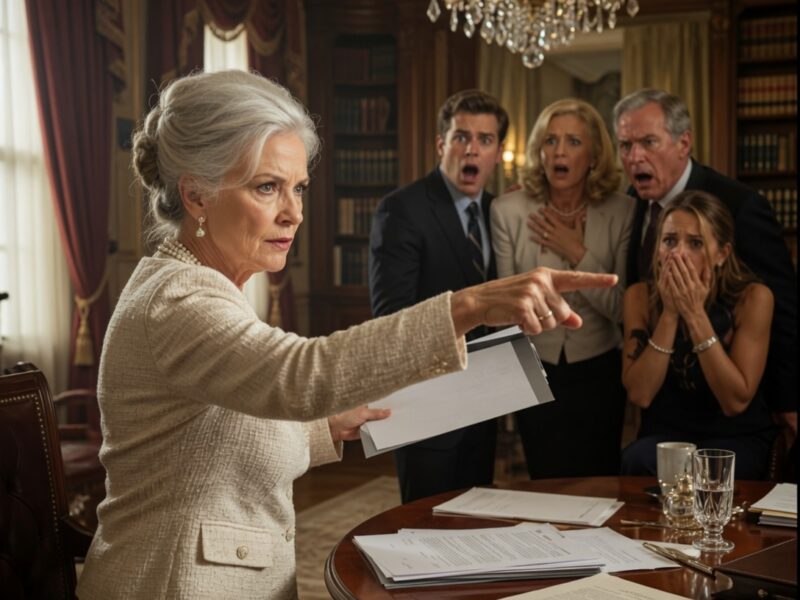
In flawless French, I said, “Too late. I already found everything.”
Celeste went pale. Philippe stared at me.
Emily whispered, “Mom?”
I removed three folders from my handbag.
The first contained Julien’s dismissal records. The second traced the shell companies to Philippe. The third showed Celeste’s apartment had been bought with money stolen from elderly clients.
Daniel had also traced a recent transfer from one victim’s account directly into the deposit for Emily’s wedding venue. Their celebration had been purchased with stolen retirement money.
Julien stood. “Those documents are illegal.”
“They were obtained through lawful discovery in an active civil investigation.”
“You have no authority.”
“I don’t,” I said. “But the investigators next door do.”
Two federal agents entered.
Philippe reached for his phone. Celeste began shouting. Julien grabbed Emily’s wrist.
“Do not believe her,” he hissed.
Emily looked at his hand, then slapped him so hard the room fell silent.
“You used me.”
As the agents approached, Julien glared at me. “You think this ends with paperwork?”
“No,” I said. “It ends with evidence.”
And I had saved the worst for morning.