Facing intense backlash from the public, a spokesperson for Tasmania’s Department of Natural Resources and Environment has spoken out regarding the methods used to relocate Neil the seal
In Primrose Sands, Tasmania, a scene that is both bizarre and high-pressure has become a local “specialty”: Neil, a one-ton southern elephant seal—and a social media celebrity in his own right—decided to claim the middle of the road as his resting place, causing significant traffic disruption this past Wednesday. However, the incident has ignited a fiery debate regarding how wildlife experts manage these “uninvited guests” who are nonetheless adored by millions.
Public Outrage and the “Viral” Backlash
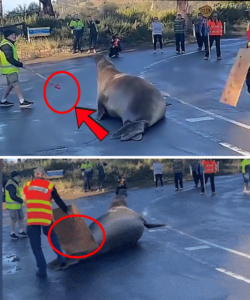
Staff from the Marine Conservation Program (MCP) were dispatched to the scene with the task of clearing the thoroughfare. In footage capturing the event, they are seen using padded poles to prod the massive animal and wooden boards to usher the giant seal away from the road. Yet, these images caused a social media “storm,” with loyal fans of Neil arguing that the methods were overly aggressive.
Jason, who manages the social media pages dedicated to Neil, could not hide his frustration. He shared the mood of the local community with nine.com.au: “The general feeling of the public is outraged, many people have made complaints.”
For Jason, who has spent years tracking Neil’s journey through a TikTok account with 1.4 million followers, using poles to prod the animal was a hard method to accept. He emphasized in a clip shared on Facebook: “I don’t agree with it. They’re trying to get him back on the beach and then they’re going to electric fence the track to keep Neil on the beach. I would have used the traffic cone to lure him without hitting him.”
Expert Perspective: Behind the Padded Poles
While the public debates the ethics of the situation, the Department of Natural Resources and Environment Tasmania offers an entirely different perspective. According to officials, Neil—born in 2020 in Salem Bay—now weighs a staggering 1,000 kg. At this size, Neil is no longer a cute seal pup but a massive, potentially dangerous, moving wall of flesh.
A department spokesperson explained the methods employed: “It is not possible to leave him in place, as this puts him at risk of being hit by a vehicle and creates a safety hazard for drivers and pedestrians.”
They further emphasized that current techniques are a result of behavioral changes in the subadult seal: “Neil is now estimated to weigh around 1000kg, and even small movements from a large wild animal can cause serious injury. As a subadult, his behaviour has changed, and techniques used during previous visits have been updated to ensure everyone’s safety. The use of padded poles, boards and noise to encourage large wildlife to move is a standard, internationally recognised approach used by trained wildlife experts.”
A High-Risk Love-Hate Relationship
Neil’s case serves as a striking example of the collision between wild nature and modern human infrastructure. Jason acknowledges that while the MCP staff’s methods made him feel “uncomfortable,” managing a wild animal that treats “the local public roads like his personal mattress” is truly an unprecedented challenge.
As an endangered species, Neil requires protection, but his very fame has become a double-edged sword. Excessive public “infatuation” can lead people to let their guard down. Experts have issued a desperate warning: the public must maintain a distance of at least 20 meters. The absence of a natural seal colony in Tasmania draws Neil toward human activity—an inevitable consequence that we, whether we like it or not, must learn to navigate more safely and rationally.