She Called It “Just Logistics” — But When Her Sister Came Home, Everything Changed
Part 1
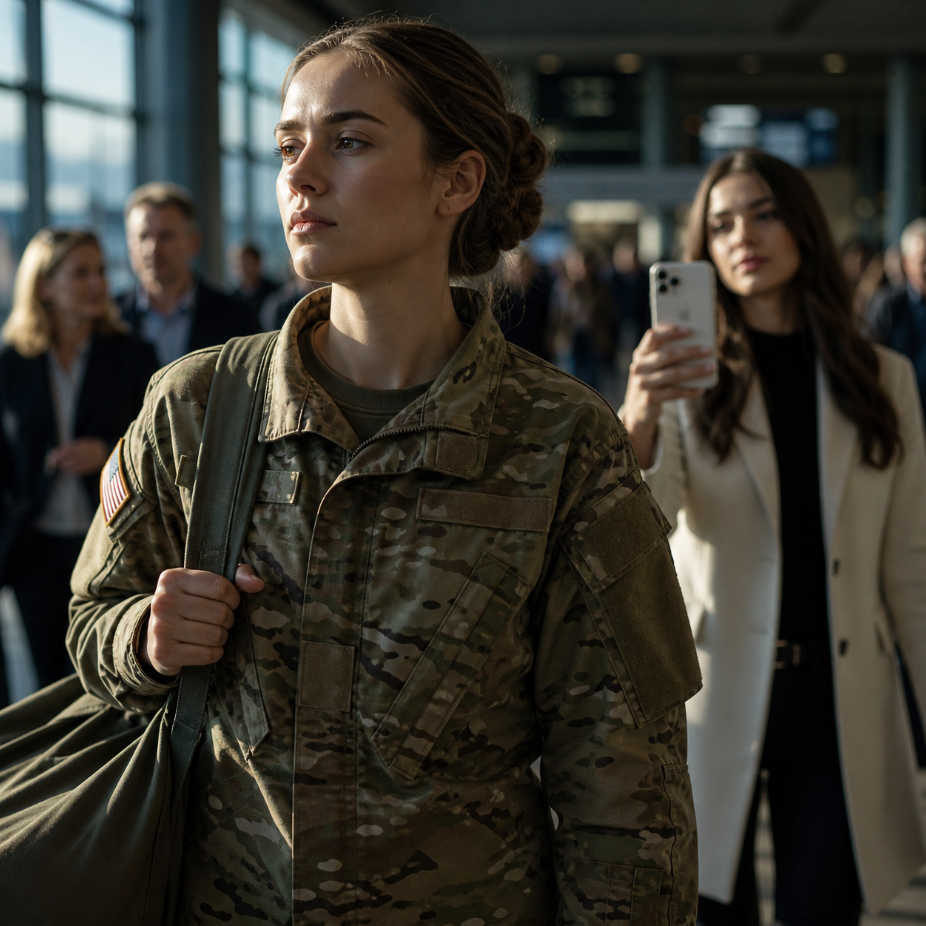
The strap of my duffel bag was biting into my shoulder hard enough to leave a groove through my uniform, and O’Hare smelled like floor polish, burnt coffee, and too many people moving in too many directions at once. Wheels clicked over tile. TSA bins slapped against metal rails. A baby cried somewhere behind me. The whole terminal was loud until Chloe lifted her phone and the noise seemed to drop behind a wall.
“Okay, go stand a little closer to the window,” she said, not to me exactly, but to the reflection she liked better than any real person. “The light’s better.”
I shifted half a step because it was easier than arguing.
She turned on her livestream with a bright smile that looked expensive. “Hey, guys. My sister is deploying today.”
Not proud. Not worried. Not even sad.
Performing.
The comments started flying up so fast they blurred into little white bars on her screen. Heart emojis. Flag emojis. People telling her she was so brave for supporting me. Chloe laughed softly, the way she did when strangers on the internet handed her a version of herself she liked.
“Look at this,” she said, angling the phone so close to my face that I could see my own expression on-screen. Flat. Tired. Hair scraped back. Jaw set. “They already think you’re some kind of hero.”
Then she lowered her voice just enough that only I could hear.
“You’re really going all that way to do logistics?” she murmured with a smirk. “Moving boxes in the desert while I’m launching a military-inspired line? Real uniforms, real grit, real aesthetics. And then there’s… whatever this is.”
She gestured toward me like I was a coat rack.
I adjusted my cap. That was always my move. Small, controlled, something to do with my hands besides ball them into fists.
Behind her, my mother hovered with the anxious energy of a stage manager. She tugged at Chloe’s sleeve, smoothing nothing. “Turn a little. Your coat looks better from that side.”
My father glanced at Chloe’s handbag and said, “Keep the logo showing.”
Not one of them asked me where I was going. Not one asked if I was scared. Not one said come back safe.
Chloe pouted at the camera, the expression she used for sponsored skincare and fake vulnerability. “It’s honestly so hard watching someone you love leave like this.”
My mother finally looked at me. “Just don’t cause trouble over there,” she said. “We can’t afford any stress right now. Chloe’s got a lot happening.”
That was my goodbye.
No hug. No hand squeeze. No awkward attempt at love.
Just logistics.
I nodded once and turned for security before the heat in my face turned into something visible. Behind me, Chloe’s voice floated after me, sweet and dramatic again for the benefit of strangers.
“She acts tough, but I know she needs us.”
I nearly laughed at that. I kept walking.
The TSA line moved in jerks. Shoes off. Laptop out. Belt in the tray. I stood there in socks on cold tile while a college kid in front of me argued about mouthwash and a little girl behind me clung to her mother’s leg. Airports force you into your head. Too much waiting. Too much fluorescent light. Too much time for old scenes to come back with fresh edges.
I remembered sitting at the kitchen table at ten years old, pencil tucked behind my ear, finishing math homework while Chloe practiced runway turns in the living room. My parents clapped when she nailed a pose. No one noticed when I got a hundred on the test.
At sixteen, I cooked dinner because Mom was working late and Dad was at the pharmacy. Chloe came home upset because a classmate had copied her mood board. My mother held her while I stirred pasta with one hand and signed a permission slip with the other.
At eighteen, I stood in our kitchen with an acceptance letter from a state college that smelled faintly of printer ink and possibility. It wasn’t glamorous, but it was mine. That same night Chloe cried because her fashion school tuition in New York had gone up.
My parents looked at me the way people look at the sturdier branch in a storm.
“You’re the practical one, Sarah,” my father had said.
“You’ll land on your feet,” my mother added.
By the end of the week, my college fund was gone.
Part 2
The desert didn’t care about anyone’s narrative.
It didn’t care about curated feeds or soft lighting or the illusion of control. It was heat and dust and wind that cut across your face like a warning. It was long days that blurred into longer nights, punctuated by the low hum of generators and the occasional distant thud that reminded you where you were.
Logistics, Chloe had said.
Moving boxes.
She wasn’t entirely wrong.
But the boxes mattered.
Everything here mattered.
Water pallets stacked in precise rows. Medical kits sealed tight. Ammo crates logged, tracked, accounted for down to the last round. A convoy leaving ten minutes late could mean a unit going without supplies. A mislabeled crate could cost someone time they didn’t have.
I learned that fast.
I learned faster when our convoy hit its first scare.
We were halfway to an outpost when the lead vehicle stopped hard, dust swallowing everything behind it. Radios crackled. Voices sharpened.
“Possible IED. Hold position.”
My hands were steady on my weapon, even if my pulse wasn’t. Training takes over in moments like that. You don’t think about home. You don’t think about what people assumed you were doing.
You just do your job.
Hours later, when we finally rolled again, the sun was already dipping low, painting everything in that harsh gold that makes even danger look beautiful from far away.
That night, sitting on a crate outside the tent, I checked my phone.
No signal, but cached notifications from earlier trickled in.
Chloe’s livestream clip had gone viral.
Millions of views.
Comments calling her “so strong,” “so supportive,” “the perfect military sister.”
There were edits too—slow-motion shots of her wiping a nonexistent tear, dramatic music layered over my blank face as if it meant something deeper than exhaustion.
I scrolled past them.
Then I saw something else.
A photo from a small account—one of the guys in my unit.
Grainy. Unfiltered.
Me, standing in the back of a truck, sweat cutting lines through dust on my face, checking inventory with a clipboard wedged against my knee.
No caption.
Just reality.
It had maybe twelve likes.
I stared at it longer than I expected.
Because that—more than anything Chloe posted—was me.
Weeks turned into months.
I got good at what I did. Not flashy-good. Not the kind of good that earns headlines. But the kind that gets things where they need to be, when they need to be there.
Reliable.
Practical.
The same words my parents used.
Except here, they meant something.
One night, a med unit came through short on supplies after an emergency call. They were exhausted, running on fumes and adrenaline. We had what they needed because I’d double-checked a shipment that morning that someone else almost signed off on.
“Who logged this?” one of them asked.
I raised a hand.
He nodded once. “You just saved us hours.”
No applause. No cameras.
Just a fact.
It stayed with me.
Later that week, I got a message from home.
Not from my parents.
From Chloe.
Hey. Quick question—what’s the exact name of that desert camo pattern you wear? Need it for a drop. Also, can you send a pic in uniform? Something raw-looking but still… you know. Good.
I stared at the screen.
Then I typed back:
No.
There was a long pause.
Then: Wow. Okay. Didn’t expect attitude from you.
I didn’t respond again.
For the first time in my life, I didn’t adjust, didn’t smooth things over, didn’t make myself smaller to keep the peace.
Out here, I wasn’t a background character.
I was necessary.
And I was starting to understand the difference.
Part 3
Coming home felt stranger than leaving.
Airports look the same no matter where you go—same lights, same noise—but I wasn’t the same person walking through them.
My duffel bag was heavier, not just with gear, but with something harder to name.
Certainty, maybe.
Or just the absence of doubt.
When I stepped into the arrivals area, I didn’t expect much.
So I wasn’t surprised when I saw Chloe first.
Phone already up.
Streaming.
“Guys, she’s back!” she said, turning in a perfect angle so the light hit her just right. “After months overseas—this is such an emotional moment.”
My parents stood just behind her, arranged like a backdrop.
My mother smiled tightly. My father gave a short nod.
Same positions.
Same roles.
For a second, it was like nothing had changed.
Then Chloe moved closer, lowering her voice without turning off the stream.
“Okay, quick—after this, we need to shoot something. Just a few clips. Reunion vibes. Maybe you hug me, I cry a little—”
“No.”
I said it clearly this time.
Out loud.
She blinked. “What?”
“No,” I repeated. “I’m not part of your content.”
The livestream kept running.
Comments exploded—confused, curious, eating it up.
Chloe forced a laugh. “She’s joking, guys—she’s always been like—”
“I’m not joking.”
The words landed heavier than I expected.
My mother stepped in, voice sharp under the smile. “Sarah, don’t start—”
“I’m not starting anything,” I said, still calm. “I’m finishing it.”
For the first time, my father looked directly at me, really looked.
Maybe he saw it then.
The difference.
“I’m not your practical backup plan anymore,” I continued. “I’m not the thing you cut when something more exciting comes along.”
Chloe lowered her phone slightly, just enough that her audience might miss the shift in her expression.
“Where is this coming from?” she whispered.
I almost laughed.
“From years of it,” I said. “From giving up things that mattered to me because you needed something more. From being invisible until it was convenient.”
Silence stretched between us, awkward and unfamiliar.
Around us, people were hugging, crying, reuniting for real.
No filters.
No scripts.
My mother’s voice softened, uncertain now. “We did what we thought was best—”
“For who?” I asked.
She didn’t answer.
Chloe glanced at her screen, at the flood of comments she could no longer control.
Then, slowly, she turned the livestream off.
Just like that.
No audience.
No performance.
Just us.
“I didn’t think it was that bad,” she said quietly.
“That’s the problem,” I replied.
Another pause.
Then my father cleared his throat. “What do you want, Sarah?”
It was a simple question.
It took me a second to answer.
“Respect,” I said. “Space. And no more taking from me to fix something for her.”
Chloe flinched, but she didn’t argue.
Not this time.
My mother nodded slowly, like she was recalibrating something that had been set one way for too long.
“Okay,” she said. “We can… try.”
It wasn’t perfect.
It wasn’t a dramatic apology or a clean resolution.
But it was real.
And for once, that was enough.
I adjusted my cap—old habit, new meaning—and shifted my duffel on my shoulder.
“Good,” I said. “Because I’m not going back to how it was.”
Then I walked forward, past them, not away—but not behind anymore either.
For the first time, I wasn’t the sturdy branch waiting to be bent.
I was standing on my own.