Part 1
By two-thirty in the morning, Riverside General always smelled the same: coffee burnt down to tar, lemon disinfectant, old air-conditioning, and that faint metallic edge that clung to trauma rooms no matter how often Environmental Services mopped the floors.
I knew that smell better than I knew perfume.
For eleven years, I had worked nights in the emergency wing and surgical intake, which meant I had spent more time under fluorescent lights than under the sun. I could tell the hour by the sound of the building. At midnight, it was phones and rolling carts and elevator chimes. At three, it was ventilators sighing, distant footsteps, someone crying behind a curtain and trying not to be heard. By dawn, it was ice machines dumping their load and the first day-shift laughter floating down the hall as if morning were a thing everybody got to have.
People called me dependable. Efficient. Steady. No one ever called me important.
That was fine. Or at least that was what I had told myself for a long time.
I was twenty-four when I came to Houston from a tiny town in Tennessee where everybody knew who your mother was before they knew your name. I had two suitcases, a nursing license, a car that overheated when you asked too much of it, and grief so fresh it sat on my shoulders like wet laundry. My mother had died six months before graduation, in a hospital room that smelled like saline and peppermint lip balm. I had held her hand through nights that never seemed to end, learning the machinery of hospitals from the wrong side of the bed rail. Somewhere in that long losing, I made myself a promise: if I ever stood on the other side of the chart, I would never let tiredness, status, or hurry make me stop seeing the person in the bed.
That promise followed me to Houston.
So did my son, eventually. Daniel was fifteen now—long arms, quiet voice, hair always falling into his eyes, and the habit of noticing things I thought I had hidden. I worked nights so I could be home when he got back from school, which sounded noble when people said it out loud and felt a lot messier in real life. It meant sleeping in pieces. It meant dinner at strange hours and alarms that cut dreams in half. It meant I missed things. A choir concert once. A parent conference twice. One birthday dinner I still felt guilty about so sharply that the memory could wake me up faster than coffee.
Daniel never weaponized any of it.
Instead he left me notes.
They appeared beside the toaster, under my keys, next to the basil on the windowsill in our apartment kitchen. Little scraps torn from his notebooks. Don’t forget your lunch. Good luck tonight. Bio test today—pray for me. My favorite one, the one I had tucked into a cheap frame, just said: I see you, Mom.
At work, I was not the kind of person people framed notes for.
I was the one who knew where the backup tubing was when central supply had already been cleaned out. I was the one residents found at one in the morning with questions they were too embarrassed to ask in rounds. I was the one who could look at a monitor, a face, a pair of hands, and tell before the numbers did that something was wrong. I trained half the new hires on our floor. I knew which patient hated apple juice and which family needed someone to say the same sentence three times before it landed. I could hear a pump alarming from two rooms away and tell whether it was occlusion or air in line.
That kind of knowledge keeps people alive. It just doesn’t come with a portrait in the lobby.
That was more Dr. Aaron Whitfield’s territory.
His picture hung downstairs near the donor wall, all teeth and confidence and white coat, like the hospital had invented him itself. Chief of emergency surgery. Harvard-trained. Conference speaker. Newspaper quotes. He was forty-four and handsome in the polished, expensive way some men are—nothing accidental, not even the looseness of his tie. People liked to say he was brilliant, and he was. That was the problem. Brilliance can get away with things kindness never would.
Whitfield didn’t scream. He didn’t throw instruments. He didn’t humiliate people in obvious, reportable ways. His cruelty was cleaner than that.
He erased you.
If you questioned him, he continued talking as if you had made a noise somewhere outside the room. If you persisted, he addressed the nearest man in a white coat instead, turning your objection into air. I had watched him do it to nurses, residents, techs, even one attending from anesthesia who happened to be younger and less famous than he was. He had a talent for making other people feel childish for noticing danger.
A month before, I’d watched a first-year resident stumble through a post-op plan Whitfield had changed verbally and never charted. The kid—Marcus Webb, twenty-six, smart, nervous, trying too hard not to look scared—had stood there blinking while Whitfield asked him, in that pleasant low voice of his, why he was “inventing confusion.” I had found Marcus later in the supply closet, sitting on an overturned box of gloves and breathing too fast.
“Start with the facts,” I’d told him. “Not his tone. The facts.”
He had laughed shakily and said, “Do you always sound like that?”
“Like what?”
“Like you’ve already survived this.”
I hadn’t answered him, because I had.
Part 2
The night it happened started like any other—too many patients, not enough beds, and a storm rolling in that made everything feel tighter, louder, more fragile.
At 2:47 a.m., they brought her in.
Female. Mid-thirties. Internal bleeding suspected. BP dropping.
Her name was Elena Cruz.
I saw it before anyone said it—her skin tone, the way she held her abdomen, the almost invisible tremor in her fingers. Not just pain. Shock creeping in.
“Prep OR,” Whitfield said, already snapping on gloves. “We don’t wait.”
“We need imaging,” I said quietly. “There’s something off—”
He didn’t look at me.
“Move.”
That was his answer.
Marcus was there too, hovering at the edge, eyes darting between monitors and Whitfield’s hands. I saw the hesitation in him—the memory of that supply closet still sitting in his chest.
“Elena,” I said, leaning close. “Stay with me. Can you tell me where it hurts most?”
She tried. Her lips moved. No sound.
Her hand twitched toward the right side—not left.
Whitfield was already marking the left.
My stomach dropped.
“Doctor,” I said, louder this time. “Symptoms don’t match. We need a scan.”
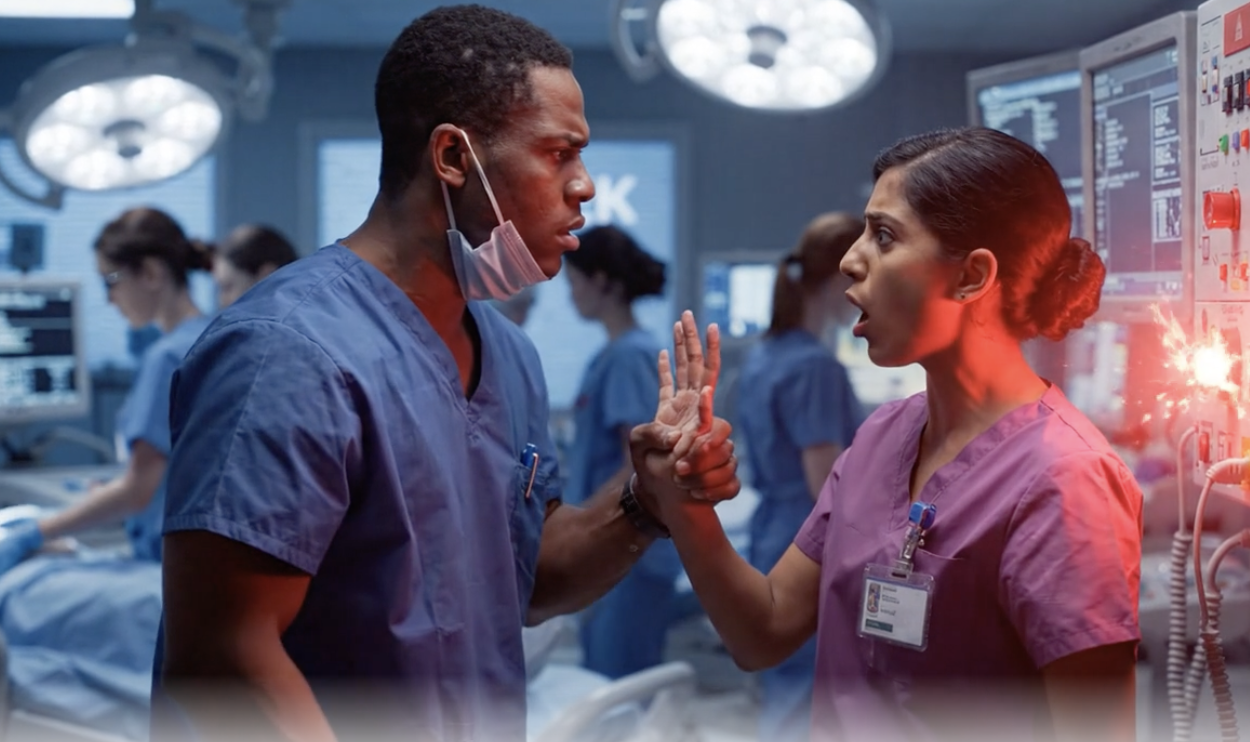
He reached out—fast, controlled—and grabbed my wrist.
Not hard enough to bruise.
Just enough to stop me.
“Step back,” he said, still not looking at me.
The room went quiet in that dangerous way. The kind where everyone hears everything but pretends they didn’t.
I felt it then—not fear.
Clarity.
The kind my mother had needed someone else to have.
“Chart discrepancy,” I said, my voice cutting through the room sharper than I expected. “Vitals, presentation, and patient response inconsistent with your call.”
He ignored me again.
But this time, I didn’t disappear.
I turned.
“Marcus,” I said. “Repeat findings.”
He froze.
Whitfield didn’t move—but the air changed.
“Right side pain,” Marcus said finally, voice shaking. “BP unstable. Possible internal hemorrhage—unclear source.”
“Thank you,” I said.
Then I did the one thing nobody ever did.
I reached past Whitfield—and hit the emergency consult override.
The alarm wasn’t loud.
But it was absolute.
It froze the room.
Policy was clear: override meant immediate second attending review. No exceptions. No ego.
Whitfield finally looked at me.
Really looked.
“You just compromised a surgical window,” he said, voice low.
“No,” I answered. “I protected it.”
Seconds later, another surgeon rushed in.
CT was ordered.
And when the scans came back—
Silence.
The bleed wasn’t where Whitfield had marked.
It was higher. Hidden. Dangerous in a way that would have been missed until it was too late.
Until she was already gone.
Part 3
No one said anything at first.
They just looked at the screen.
Then at Whitfield.
Then, slowly, at me.
The surgery went differently after that. Carefully. Precisely. The right way.
Elena survived.
By sunrise, the storm had passed. The hospital smelled like morning again—coffee, clean floors, something almost like relief.
I was charting when Marcus found me.
“You didn’t even hesitate,” he said.
I thought about that.
About my mother.
About Daniel’s note in the frame.
“I did,” I said. “I just didn’t let it decide.”
Word spread quietly.
Not gossip. Not drama.
Just facts.
That’s how real things move in hospitals.
No one applauded. No one made speeches.
But something shifted.
People started listening a little sooner.
Double-checking a little more openly.
And Whitfield?
He never grabbed my wrist again.
A week later, I came home to another note from Daniel.
It was sitting by the toaster, like always.
I see you, Mom.
This time, I smiled before I even picked it up.
Because for the first time in a long while—
So did everyone else.
News
A QUIET L0SS… A LIFE THAT MEANT SO MUCH… — MEL SCHILLING’S PARTNER SHARES A MAJOR DECISION AFTER HEARTBREAKING L0SS
Exactly one month after saying goodbye, Mel Schilling’s widower has shared some bittersweet news with her adoring MAFS fans. To the background…

WHAT DID YOU DO, MOM? — A Question Caught on Camera in the Carolina Flores Gómez Case That Sent Chills Down Everyone’s Spine…
Bone-chilling new video captures the moment a former Mexican beauty queen is gunned down in front of her baby —…
SHE THOUGHT SHE WAS SAFE… THEN EVERYTHING CHANGED — Beauty Queen Case Leaves Mexico Demanding Answers!
Bone-chilling new video captures the moment a former Mexican beauty queen is gunned down in front of her baby —…
JUST A JOKE… OR SOMETHING MORE? — Prince William MAKES A SURPRISING HEIGHT JOKE RIGHT AS Prince George HAS EVERYONE TALKING
Prince William is 6 feet 3 inches, and it appears his eldest son may be taking after him Prince William,…

BREAKING — MEGHAN MARKLE MENTIONS “THE HARDEST SEVEN YEARS” ON INSTAGRAM, ONE DETAIL HAS EVERYONE TALKING…
The Duchess of Sussex also shared a horoscope post that referenced themes of self-worth and insecurity Meghan Markle in Washington,…
POLICE CONFIRM TRAG-IC UPDATE IN LONDON PARK INCIDENT INVOLVING MOTHER AND CHILD
4 The entrance at Elthorne Park last nightCredit: Jordan Reynolds/PA Wire 4 The pair were recovered from the water,…
End of content
No more pages to load