King Charles’s Father’s Day tribute is filled with deep and heartfelt meaning
Father’s Day, celebrated on June 21, 2026, was more than just a tribute to paternal bonds for the British Royal Family; it served as a poignant reflection of the sharp contrasts between power and intimacy. While King Charles III shared a nostalgic moment to honor his late father, Prince Philip, public attention was inevitably drawn to a persistent “void”: the strained relationship between the King and his younger son, Prince Harry.
A Legacy of Heritage and Reminiscence
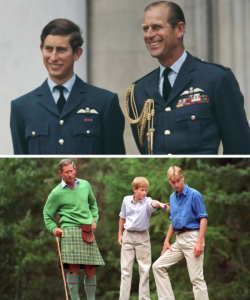
Across official channels, the Royal Family released a moving black-and-white photograph from 1971. It captures a young King Charles receiving his pilot wings at RAF Cranwell, standing beside his father—who passed away in 2021 at the age of 99. The accompanying caption carried an air of quiet contemplation: “Celebrating all Fathers, and thinking of those who wish they could be with their Dads, today.”
The selection of this image was not merely a personal tribute; it was a lesson in continuity. For years, the Royal Family’s Father’s Day imagery has been iconic: from young Charles and Princess Anne being pushed on a swing by Prince Philip to memories of Queen Camilla with her own father, the late Major Bruce Shand. Yet, this year, the festive atmosphere was punctuated by the 44th birthday of the Prince of Wales, William—the eldest son who remains the bedrock of succession.
The “Security” Divide
Despite the day’s sentimentality, the Windsor family portrait remains incomplete due to the rift with Harry and Meghan Markle. The 2020 departure and their new life in California have yet to provide a “safe harbor” for their father-son relationship. The primary obstacle, as Prince Harry himself has asserted, remains the issue of state-funded security.
Harry, 41, has publicly fought in London’s High Court to reclaim the right to protection when returning to his home country. He spoke with deep reflection about his role as a parent: “The U.K. is my home. The U.K. is central to the heritage of my children and a place I want them to feel at home as much as where they live at the moment in the United States. That cannot happen if there is no possibility to keep them safe when they are on U.K. soil.”
He further emphasized his responsibilities as a husband and father: “I can’t put my wife in danger like that, and given my experiences in life, I’m reluctant to unnecessarily put myself in harm’s way too.”
A Hope for Future Reconciliation
Despite legal hurdles and lingering coldness, the desire for reconciliation has never fully faded. In previous comments to the BBC, Harry expressed a troubled perspective on the passage of time: “Life is precious. I don’t know how much longer my father has. He won’t speak to me because of this security stuff, but it would be nice to reconcile.”
While a 55-minute meeting in London in September 2025—their first in-person encounter in 19 months—offered a glimmer of hope, Harry’s planned return to the U.K. in July 2026 for the one-year countdown to the Invictus Games Birmingham 2027 has become a lightning rod for speculation. Will this visit bridge the cracks, or will it only sharpen the contrast between royal duty and familial affection?
On this day dedicated to fathers, King Charles III is not merely a monarch; he is a father navigating the most difficult choices of his life. That vintage 1971 photograph serves as a reminder that beneath layers of royal regalia, paternal bonds remain the most fragile yet enduring threads—threads that sometimes require more than power alone to maintain.