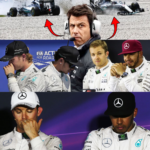

Ten years on and the wounds from one of Formula 1’s most explosive team-mate clashes still haven’t fully healed.
In a sensational new interview, Nico Rosberg has revisited the infamous first-lap crash with Lewis Hamilton at the 2016 Spanish Grand Prix – and delivered a blunt verdict that will send shockwaves through the paddock: “It wasn’t a mistake. It was inevitable.”
The German, who went on to snatch the 2016 world title from his bitter Mercedes rival in one of the most intense title fights in modern F1 history, has now lifted the lid on the exact sequence that destroyed both Silver Arrows on lap one at Barcelona.
Rosberg was in the wrong engine mode, leaving him dramatically slower coming out of Turn 3. Hamilton, charging with far higher speed and electrical energy, saw what looked like a golden opportunity to reclaim the lead. What followed was a high-speed collision that took both drivers out of the race – and nearly tore the dominant Mercedes team apart.
But that’s not all.
In the immediate aftermath of the crash – and a second collision later that season – team boss Toto Wolff was so furious that he took the extraordinary step of temporarily “firing” both drivers as an internal warning. He even contacted Mercedes CEO Dieter Zetsche to make it official. The dramatic move was never publicly announced at the time, and has only now been fully revealed by Wolff himself in recent explosive interviews.
The revelation has reignited one of F1’s greatest rivalries and left fans debating once again: was the Barcelona smash really inevitable because of Rosberg’s engine setting error – or was it pure racing aggression that was always going to end in tears?
The crash that changed everything: Barcelona 2016
It was supposed to be a straightforward Mercedes one-two. Rosberg had qualified on pole, Hamilton alongside him on the front row. The Silver Arrows were untouchable that season, but the personal battle between the two team-mates had already reached boiling point.
As the lights went out in Barcelona, Rosberg got the better launch and took the lead around the outside into Turn 1. But just seconds earlier, while lining up on the grid, he had made a critical error on his steering wheel.
Nico was in the wrong engine mode – a setting that meant he did not have access to the full electrical energy (ERS) deployment coming out of the slow Turn 3. His car suddenly lost power, becoming a sitting duck as the pack accelerated towards Turn 4.
Hamilton, with the correct higher-power setting, closed the gap at frightening speed. Seeing Rosberg apparently struggling, the Briton went for the inside line. Rosberg, sensing the threat, moved across aggressively to defend.
What happened next was chaos.
Hamilton’s Mercedes hit the grass, lost control, spun wildly and slammed into the side of Rosberg’s car. Both cars were out on the spot – a humiliating double retirement for the team that was supposed to be cruising to another dominant season.
Toto Wolff later confirmed: “Nico was in the wrong setting and that’s why he lost power coming out of Turn 3. He did not have as much electrical energy as Lewis had. That explains why everything went so quickly because there was such a discrepancy in speed.”
Rosberg has now reflected on the moment with remarkable honesty. “It wasn’t a mistake in the sense of carelessness,” he explained. “But the situation became inevitable the moment I came out of that corner slower than expected. Lewis was flying in with so much more speed. When I blocked late and aggressively, he had nowhere to go. He kept it flat on the grass – which was unbelievable – and then… bang.”
He added that data showed Hamilton never lifted off the throttle even after going onto the grass, turning what might have been a near-miss into a full-scale disaster.
The stewards ultimately called it a racing incident – no penalties for either driver. But inside the Mercedes garage, the atmosphere was toxic.
Toto Wolff’s secret “sacking”: The hidden punishment that shocked the team
The Barcelona crash was bad enough. But when the two collided again later in the season, Wolff reached breaking point.
In a stunning recent admission, the Mercedes team principal revealed he was so angry that he effectively temporarily fired both Hamilton and Rosberg as a drastic internal warning.
“I called my chief executive officer, Dieter Zetsche, and said, ‘Listen, you need to sign something.’ He called me back and said, ‘You’re making both drivers redundant?’ And I said, ‘Yeah, because otherwise they won’t understand how important it is – the interest of the brand and the team above their own.’”
Wolff went even further, sending both drivers an email telling them that, at that moment, they were “not part of the team.” The intention was crystal clear: a short, sharp shock to remind the two superstars that their personal war was threatening the entire organisation.
Crucially, this dramatic move was never made public at the time. The paddock and media had no idea that Wolff had gone nuclear behind closed doors. Only now, a decade later, has the full story emerged – adding a whole new layer of intrigue to the 2016 season.
Wolff later backed down, of course. Both drivers kept their seats and the rivalry continued all the way to the Abu Dhabi finale, where Rosberg clinched the title after Hamilton’s controversial slow-down tactics failed to hand the win to a rival.
But the “temporary sacking” served its purpose. The team pulled together enough to secure the constructors’ championship, even as the drivers’ battle raged.
Rosberg vs Hamilton: The rivalry that defined an era
The 2016 season remains one of the most compelling in F1 history precisely because it pitted two incredibly talented team-mates against each other in identical cars.
Hamilton came into the year as the reigning champion and the faster qualifier for much of the season. Rosberg, son of 1982 world champion Keke Rosberg, was determined to prove he belonged at the very top.
Their relationship had already soured in previous years, but 2016 took it to another level. Crashes, accusations, mind games and psychological warfare became the norm.
Rosberg later admitted he deliberately tried to “mess with Lewis’s head” – losing weight before key races to gain tiny advantages and getting under his rival’s skin. Hamilton, for his part, felt the team was sometimes favouring Rosberg and grew increasingly frustrated.
The Barcelona crash only deepened the fracture. Rosberg said the incident made the already tense dynamic inside the team even worse. “It was extremely intense,” he recalled. “We were fighting for the championship and suddenly we take each other out on lap one. That doesn’t happen very often.”
Yet Rosberg insists there was no deliberate intent from either side. “Lewis tried to go for the inside. I blocked very late, very aggressively. Then it came to the collision, which really is the worst case. And it’s also dangerous.”
Hamilton, meanwhile, has always maintained he was simply seizing an opportunity created by Rosberg’s slower exit from the corner. The speed difference made the move look inviting – until it wasn’t.
The bigger picture: Team orders, crashes and championship glory
The 2016 season was full of drama beyond Barcelona. There were further clashes, controversial team radio messages, and the infamous Abu Dhabi finale where Hamilton tried to back Rosberg into the pack in a last-ditch attempt to snatch the title.
Rosberg held firm, finished second, and became world champion – only to retire days later, saying the mental and physical toll of battling Hamilton had left him exhausted.
Many observers believe the Barcelona crash was a turning point. It forced Mercedes to impose stricter rules on the drivers and reminded everyone how quickly intra-team rivalry could destroy a season.
Wolff’s secret “firing” showed just how seriously the Austrian took the threat. He has repeatedly said he would never allow the drivers’ personal ambitions to damage the team’s performance or reputation.
In later years, Wolff has spoken warmly of both men, acknowledging that their rivalry pushed Mercedes to even greater heights. But he has never shied away from admitting how close the team came to imploding in 2016.
Ten years later: Lessons from the most expensive crash in F1 history?
A decade on, the images of the two silver cars tangled in the gravel at Barcelona still evoke strong emotions among fans.
For some, it remains a classic racing incident born of two alpha males pushing the limits. For others, Rosberg’s engine mode error was the root cause that made the collision almost unavoidable.
Rosberg’s latest comments – “It wasn’t a mistake. It was inevitable” – seem to split the blame while acknowledging the role his own setting error played in creating the high-speed mismatch.
Hamilton has rarely revisited the incident in detail in recent years, preferring to focus on his record-breaking career and move to Ferrari. But the rivalry remains one of the most discussed in the sport.
Today, both men are in very different places. Rosberg works as a pundit and successful podcaster, often reflecting on his intense battles with Hamilton with a mixture of pride and relief. Hamilton continues to chase an eighth world title and remains one of the most recognisable athletes on the planet.
Yet the ghost of 2016 lingers. Whenever the two appear together – whether at events or in interviews – the chemistry is still electric. Respect mixed with the memory of old wounds.
Toto Wolff, now one of the most powerful figures in F1, looks back on that season with a wry smile. The “temporary firing” that was never public at the time has become another colourful chapter in Mercedes’ dominant era.
Why this story still matters in 2026
As Formula 1 evolves with new regulations, new teams and new stars, the 2016 Rosberg-Hamilton war serves as a timeless reminder of what happens when two elite drivers in the same car refuse to yield.
It shows the razor-thin margin between brilliance and disaster. A single wrong switch on the steering wheel. A split-second decision to block or go for the gap. A team principal pushed to the brink.
Rosberg’s verdict – “It wasn’t a mistake. It was inevitable” – feels like the perfect summary. Not because anyone planned the crash, but because the combination of championship pressure, machine settings and raw competitive instinct made it almost impossible to avoid once the speed difference appeared.
And the fact that Toto Wolff felt forced to secretly “fire” both his superstars to restore order? That speaks volumes about just how close Mercedes came to self-destruction at the height of its powers.
Ten years later, the crash at Barcelona remains one of F1’s most dramatic moments – not just for the spectacular visuals, but for the human story behind it.
Two friends turned fierce rivals. One wrong engine mode. One desperate lunge. One team boss who refused to let personal egos destroy a dynasty.
It wasn’t a mistake.
It was inevitable.
And Formula 1 has been all the richer for it.
News
“Max Verstappen Announces Shock Retirement Plans After F1 — ‘This Will Be My Final Race’”
The Seismic Shift in Motorsports: Max Verstappen Announces Retirement and a Bold New Chapter The global racing community stands in…
“Stefano Domenicali Sparks Heated Debate After Bluntly Defending Battery-Powered Overtaking Tech — But It’s His Message That Truly Divided Fans”
The Great Technical Schism of Formula 1: Innovation vs. Pure Racing Tradition The landscape of Formula 1 has reached a monumental crossroads…

Netflix Has Quietly Released a Hidden Emotional Drama — and Viewers Are Calling It ‘Painfully Beautiful’
Netflix has released the official trailer for Remarkably Bright Creatures, which looks to be a heartfelt adaptation of Shelby Van Pelt’s bestselling…

“‘You Can’t Replace the Original!’ Netflix Slammed After ‘Little House on the Prairie’ Reboot Trailer Drops”
Netflix fans were left divided after watching the first trailer for the Little House On The Priairie reboot – with some…
“The Testaments Sparks Outrage Over Shocking Dentist–Teen Patient Abuse Scene”
Disney+ viewers were left sickened by a ‘vile’ The Testaments scene showing a sexual abuse act between a dentist and…

“Warning: Netflix’s Latest Family Crime Series Is Impossible to Turn Off”
Looking for an epic new crime drama to binge-watch this week? The hit TV series, Animal Kingdom, has just landed on Netflix,…
End of content
No more pages to load