Betrayed in the line of duty: The soldier stayed alone in the ambush to save his comrades
The night wind sliced through the shattered concrete walls like thin blades. The city of Al-Hadar lay in darkness, lit only by a few flickering lights and the distant barking of dogs. A U.S. Army special operations team pressed themselves flat against the roof of a low building, watching their target through infrared scopes. Lieutenant Daniel Carter lowered his optics, took a slow breath, and glanced at the men beside him.
“We’ve got less than twenty minutes before the patrol returns,” he whispered over the comms. “Target is on the second floor, east side. The hostage is still alive.”
It was the last solid piece of information they had before everything began to fall apart.
The mission had seemed simple: infiltrate, extract an American engineer taken hostage, and exfiltrate before enemy forces could react. But war had never cared much for plans.
Carter’s team had six men—names worn familiar through months of surviving side by side. Jackson, the sniper, steady and cold under pressure. Morales, the comms specialist, always able to crack a joke at the worst possible moment. Singh, the quiet and precise engineer. And Walker—the youngest, just twenty-two, his eyes still carrying something the war hadn’t fully stripped away.
They moved in silence, slipping down a pitch-black stairwell, each step light as a shadow. Carter led, rifle raised, senses stretched tight. He had led missions before, faced worse than this—but never allowed himself to grow careless.
As they reached the target building, everything still went according to plan. Jackson stayed in overwatch. The rest entered through the rear. Singh handled the lock in seconds.
Inside, the air was thick, damp, and stale. Their footsteps disappeared into the heavy silence. Morales muttered, “Signal’s weak… something’s off.”
Carter raised a hand. Silence.
They had just reached the base of the stairs when a faint metallic click echoed—a tiny sound, but enough to send a chill down Carter’s spine.
“Hold,” he whispered.
Too late.
A blinding flash erupted, followed by an explosion that tore through the building. A trap. The structure shook violently. Carter’s ears rang as he was thrown into the wall. When he struggled back up, the world was muffled, distorted.
“Ambush! Fall back!” Jackson’s voice crackled over the radio, buried under gunfire.
Bullets rained down from above. Singh dropped in front of Carter without a sound. Morales dragged Walker into cover, firing back.
“We’re compromised!” Morales shouted.
Carter gritted his teeth, pulling Singh closer—but the empty look in his eyes said enough. No time to mourn.
“Jackson, cover! We’re pulling out!” Carter ordered.
The formation collapsed. The plan shattered. And the hostage—still somewhere upstairs.
They tried to retreat the way they came, but the enemy had already closed in. Bullets tore into walls, doors, the air itself. Walker stumbled and went down with a cry.
“My leg!”
Carter turned. Blood spread quickly from Walker’s thigh, dark in the dim light.
“Morales, get him up!”
“We won’t make it!” Morales shouted, panic breaking through. “They’re closing in!”
Another explosion sounded outside—Jackson still buying them time.
Carter scanned the area. The only escape was an alley behind the building—but reaching it meant crossing open ground with no cover.
“Listen,” Carter said quickly. “I’ll stay. Hold them off. You two get Walker out. Rendezvous with Jackson.”
Morales froze. “No, sir—we go together—”
“That’s an order.”
Carter’s eyes left no room for argument.
Walker tried to push himself up. “Sir… don’t—”
Carter placed a firm hand on his shoulder. “You’re going home. You hear me?”
A beat of silence. Then Morales nodded, jaw tight. He hauled Walker up, slinging the young soldier’s arm over his shoulder.
“We’ll come back,” Morales said.
Carter didn’t answer.
He turned, reloaded, and stepped out of cover. His silhouette became visible in the flickering light—a perfect target.
Gunfire erupted.
He fired with precision, one shot at a time, keeping the enemy at bay. Time stretched unbearably—each second heavy, dragging. He didn’t know how far Morales and Walker had made it. Only that he had to hold as long as possible.
A bullet grazed his shoulder, spinning him slightly. Warm blood spread, but he stayed on his feet.
In a brief pause between bursts of gunfire, memories surfaced—his wife’s gentle smile, his daughter taking her first steps. He had promised he would come home.
But not all promises survive war.
The distant thump of a helicopter echoed—maybe reinforcements, maybe imagination. Carter couldn’t tell anymore. He only knew he was still standing. Still firing. Still fighting.
A shadow moved at the edge of the alley—enemy closing in. Carter turned, squeezed the trigger.
The final shot rang out.
Then silence.
At sunrise, the city returned to its uneasy stillness. The walls still stood, scarred with the marks of the night’s violence.
At the extraction point, Morales sat against the wheel of an armored vehicle, his hands still trembling. Walker lay on a stretcher, bandaged, breathing shallow but steady.
Jackson approached, removing his helmet, his expression heavy.
“He held them off long enough,” Morales said quietly. “If it wasn’t for him…”
No one finished the sentence.
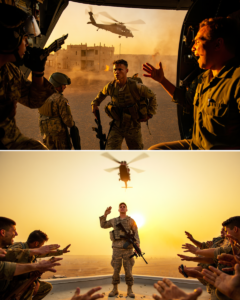
A helicopter descended, kicking up dust. Soldiers moved quickly, loading Walker first. Morales lingered a moment longer, staring back toward the city—toward where Carter had stayed behind.
There was no trumpet. No ceremony. Only the heavy silence of the living.
But within that silence, one truth remained clear:
He chose to stay.
And because of that, the others made it home.