Editor’s Note: The following contains spoilers for The Pitt Season 2, Episode 7, and mentions sexual assault.
If Season 1 of The Pitt proved the hospital could survive visible catastrophe, Season 2 is determined to test whether it can withstand the invisible kind.

Episode 7 pivots away from physical violence and into something far more insidious: systemic collapse. A coordinated cyberattack shuts down two nearby hospitals, sending shockwaves across the city’s healthcare network. In a move framed as “preventative,” CEO Trent Norris orders Pittsburgh Trauma’s entire digital infrastructure taken offline. No patient databases. No lab portals. No imaging archives. No internal messaging. Just silence where information once flowed.
The decision may be logical on paper — but in practice, it detonates the fragile equilibrium holding the ER together.
Dr. Robby (Noah Wyle) learns about the shutdown after the fact, undercutting his authority and leaving him scrambling to impose order on a team already stretched beyond capacity. Communication fractures instantly. Departments that once operated as a synchronized organism are now isolated limbs, passing handwritten notes and relying on memory in a profession where memory is never enough.
The emotional stakes compound the procedural ones.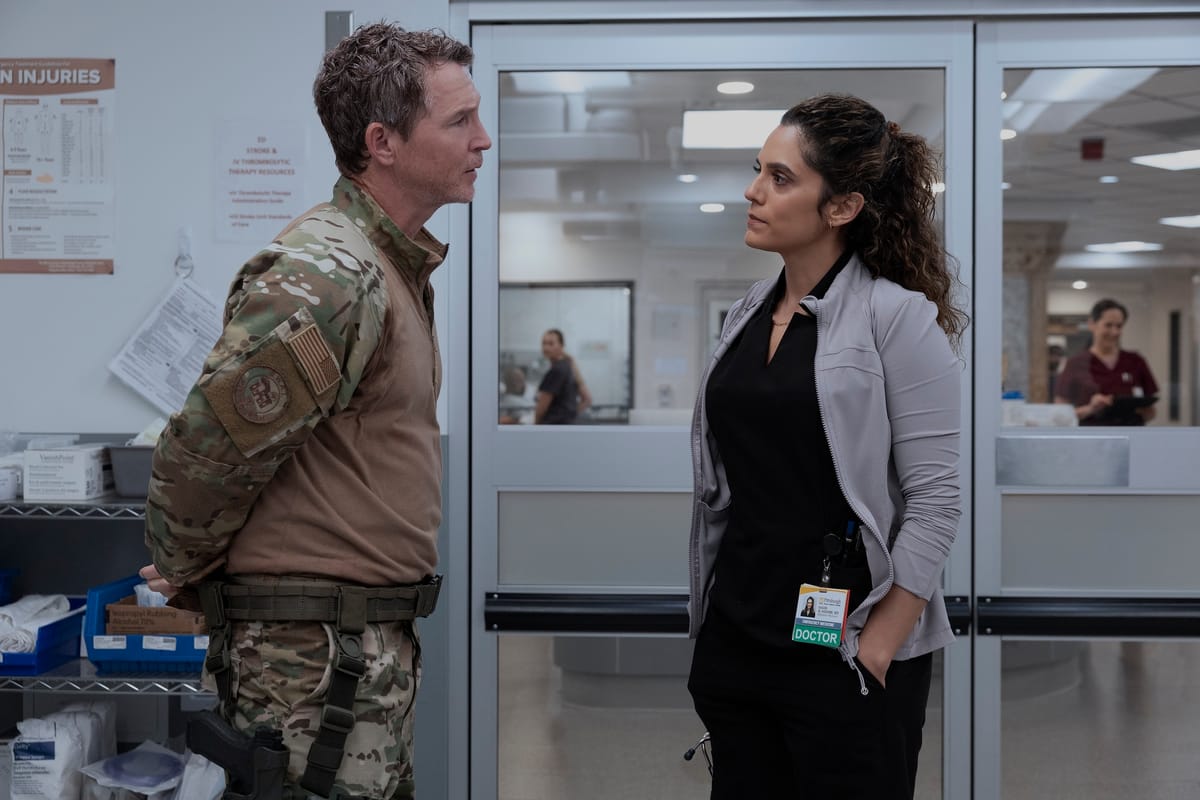
Dana Evans (Katherine LaNasa) is in the middle of processing Ilana Miller’s rape kit — a painstaking, trauma-informed procedure requiring meticulous documentation. Without digital systems, every label, every timestamp, every chain-of-custody detail becomes more vulnerable to error. The weight of that responsibility is suffocating. One oversight could jeopardize justice.
Elsewhere, the ER’s patient load continues to swell. Overflow cases from the shuttered hospitals flood in, colliding with ongoing crises: Roxie Hamler’s terminal diagnosis, the fallout from Louie Cloverfield’s death, and Jackson Davis’ precarious condition. The staff must now divide their attention between new arrivals and fragile long-term cases — without the tools they’ve come to depend on.
Veterans like Dana and Dr. Jack Abbot (Shawn Hatosy) adapt with gritted teeth. They’ve practiced medicine in the analog age before. But for younger physicians such as Trinity Santos (Isa Briones) and Victoria Javadi (Shabana Azeez), this is uncharted territory. Their training emphasized efficiency through technology. Now they’re forced to build a workflow from scratch while under relentless pressure.
The episode subtly critiques modern medicine’s paradox: technology enhances care — until its absence exposes how brittle the system truly is.
Dr. Baran Al-Hashimi’s (Sepideh Moafi) earlier enthusiasm for generative AI tools feels especially ironic in hindsight. The promise of reduced overtime and optimized charting now seems hollow against the stark reality of manual overload. The show doesn’t condemn innovation outright; instead, it asks a sharper question: Have hospitals mistaken convenience for resilience?
Meanwhile, personal tensions simmer dangerously close to eruption. Mel King’s (Taylor Dearden) anxiety over her professional future intensifies under scrutiny. Samira Mohan (Supriya Ganesh) struggles emotionally after losing Orlando Diaz from her care. Trinity juggles mentoring responsibilities while dodging the psychological minefield that is Dr. Frank Langdon (Patrick Ball). Every character operates on the edge of burnout — and the blackout only accelerates the descent.
What makes Episode 7 so devastating is its restraint. There’s no dramatic score swelling over collapsing ceilings. No gunshots echoing through corridors. Instead, the horror unfolds in quiet moments: a misplaced chart, a delayed lab result, a nurse second-guessing a dosage without digital verification.
It’s procedural dread — and it feels chillingly plausible.
By the end of the hour, The Pitt reinforces a brutal truth: crises aren’t always explosive. Sometimes they arrive as a precautionary email, a flickering cursor, or a system shutdown meant to prevent disaster that inadvertently creates one.
Season 2 isn’t trying to outdo the spectacle of Season 1. It’s doing something arguably braver — proving that tension doesn’t require spectacle at all. In a hospital already stretched to its limits, removing technology doesn’t just complicate the work.
It exposes every fracture beneath it.
News

Outlander Season 8 Episode 8 Shock: A Devastating Loss Pushes the Frasers to a Breaking Point
After a devastating episode, it’s hard to think that Outlander can offer hope and brightness. However, that’s exactly what we…

Netflix Stuns With Epic Crossover: Harry Bosch and Mickey Haller Collide in a High-Stakes War for Justice
Netflix just ignited the crime-drama world! Harry Bosch and Mickey Haller are finally colliding in a crossover so intense it feels like TV history…

“I Didn’t Expect It to End This Way” — César Domboy’s Exit From Outlander Sparks Emotional Fan Reaction
The End of an Era for Fergus Fraser The Ridge will never be the same. In a move that has…
A Quiet Aquarium… A Shocking Truth — Remarkably Bright Creatures Unveils an Unforgettable Emotional Mystery
Netflix has just released the official trailer for Remarkably Bright Creatures, a heartfelt adaptation of the bestselling novel by Shelby Van…

Enola Holmes 3 First Look: Long-Awaited Reunion Sparks Romance—and a De-adly Conspiracy in Victorian London
Clue-sniffing and romance on the beach? If the first-look photos of Enola Holmes 3 are any indication, our favorite detective is in…

High Potential Season 3 Shock: Morgan and Karadec’s Secret Wedding Sparks a Dark Threat to the NYPD
High Potential renewed for season 3 with new showrunner after season 2 finale © High Potential renewed for season 3…
End of content
No more pages to load